You Have 6 Months To Lock The F*ck In
The next 6 months can outperform the last 10 years. Here’s the protocol:

Six months from today, you will either be someone who proved that locking in works, or someone who proved that hedging doesn't.
There is no third option.
The six months start the day you decide they start. Not the first of a month. Not a new year. Not January when everyone else has socially permitted themselves to begin. The day you decide.
Most people will not decide. They will continue what they're already doing, which is what they were doing six months ago, which is what they were doing the six months before that. They will read this letter, agree with it, close the tab, and continue. That's the whole point of the letter. To name what continuing actually costs, so you can see it clearly and decide whether you want another six months of it.
Here is the part of the math nobody wants to put on the page.
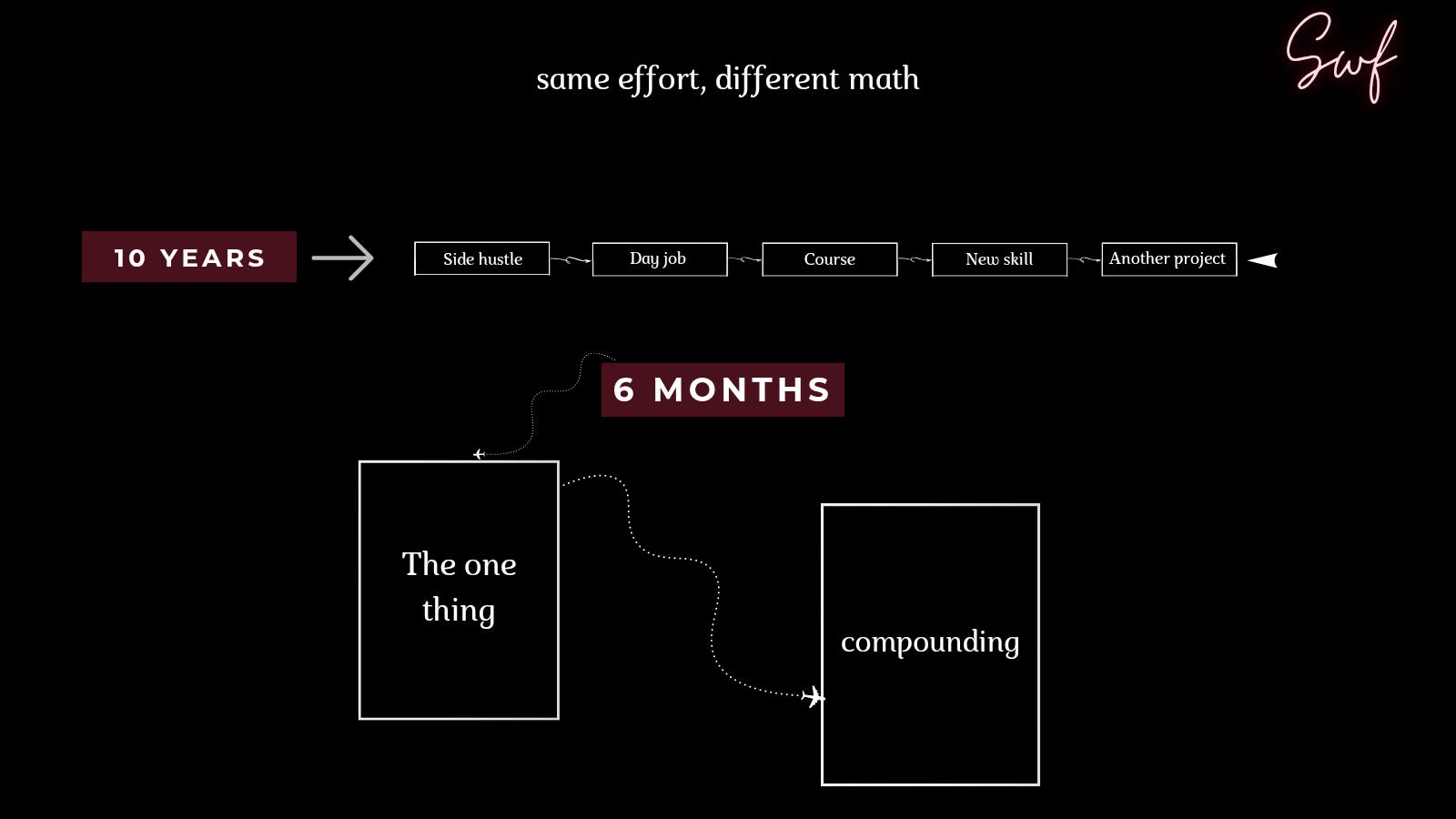
Six months of focused, locked-in work on one thing will outperform ten years of dispersed, hedged work on five things. The math doesn't care how much you wanted the ten years to count. The ten years didn't count. The reason they didn't count is that nothing compounded. Nothing was given the chance to. Every time you started to make real progress on one direction, you split your attention to chase the next one, and the compounding reset to zero. Five times. For ten years. That's why you feel like you haven't moved.
You moved. You moved in five different directions, and the net was almost nothing. That isn't a personal failing. That is the structural cost of refusing to pick a single one.
This letter is going to make the case for picking one. For six months. For the longest period of focused, locked-in work most readers will have ever sustained. And it's going to walk you through what happens during those six months, what the protocol looks like, and why this is the most important thing I think anyone running a one-person business can do in any given window of their life.
If you've read this far, I want to give you one more chance to close the tab before we go further. Because the rest of this letter is going to be uncomfortable to anyone who is hedging, which is most readers. If you're hedging, keep reading. If you're not, you already know what I'm about to say.
Why most people will waste the next 6 months
There are four reasons. Each one is structural. Each one is invisible from the inside.
One: most people don't believe six months can change a decade
So they hedge. They keep the day job and start the side project. They keep the side project and start the second side project. They keep all three and start a fourth thing in case any of the first three doesn't work. The hedge feels like prudence. It is the death of compounding.
The reason most people don't believe six months can change a decade is that they have never run the experiment. They have never picked one thing and committed to it for six uninterrupted months, so they have no internal evidence that focus produces what dispersion can't. They've only experienced dispersion. Dispersion has trained them to expect very little. When you've only ever lived inside flat progress, exponential progress sounds like a marketing scheme.
It isn't. It's just what compounding does when you stop interrupting it.
Two: hedging looks like discipline from the inside
You're working on five things. You're posting on three platforms. You're learning two skills. You're optimizing your morning routine, your evening routine, your nutrition, your finances, your relationships, your portfolio. It feels like a serious life. It feels like work. You go to bed tired.
The exhaustion is the signal. You are exhausted because dispersion is exhausting. You are not exhausted because you are making progress. You are exhausted because you are doing the metabolic work of twelve simultaneous low-grade efforts, none of which is getting enough attention to compound.
A focused life is less tiring than a dispersed one. That sentence sounds like a lie until you've lived inside both.
Three: most people only believe in lock-in around January
The rest of the year, they treat starting as suspect. Bad time to make changes. The holidays are coming. The summer is half over. I'll wait until Monday. Every month has a built-in excuse to defer. Only one month ‘January’ has a built-in cultural permission to begin. So people store up their ambition for January, fail to execute on it by February, and resign themselves to another eleven months of waiting.
This is the largest waste of time in any year, and it is invisible because everyone is doing it. The whole culture is structured around the suspicion that starting in any other month is somehow wrong. It is not wrong. It is the only honest place to start, because the only time you can start is now.
The next six months are now. Whatever six months you're reading this in.
Four: people who lock in look insane in real time
They cut things others don't cut. They say no to opportunities others say yes to. They turn down dinners, projects, partnerships, side bets, "quick favors," and the slow social drift that fills most people's calendars. They look extreme. They look obsessive. They look not-balanced.
In twelve months they look like geniuses.
In real time they look unhinged.
Most people cannot tolerate looking unhinged for six months. They cannot tolerate the friends who don't understand. They cannot tolerate the family member who keeps asking if they're okay. They cannot tolerate the small daily social cost of being the person who is no longer available for what everyone else is available for. So they stay available. They stay balanced. They stay average. They wait until January, when locking in is socially permitted, then fail to execute on it, then wait again.
The reason locked-in people compound is not that they're smarter. It's that they were willing to look insane for the time it took for the math to catch up.
Pick one thing:
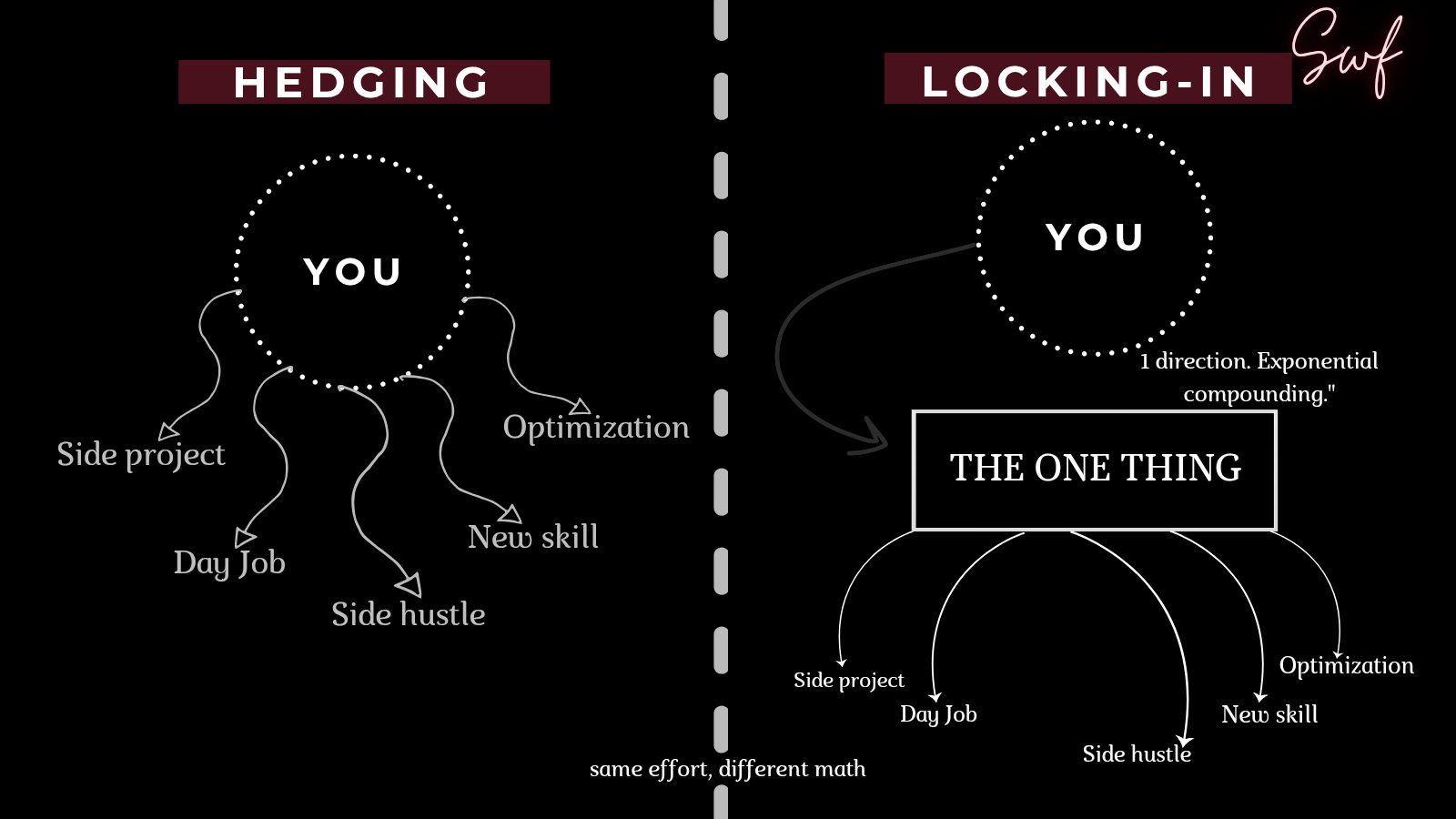
One business. One offer. One skill. One financial system. One creative project. One direction.
Not five. Not three. Not "my top priorities." One.
The other things still exist. They don't get killed. They just get benched. For six months. While the one thing gets every input it needs to compound.
This is the move most people refuse to make. They want to keep optionality. They want to keep all the doors open. They want a portfolio of light efforts because a portfolio feels safer than a bet. The problem is that a portfolio of light efforts is a guaranteed mediocre outcome. A single committed bet is the only thing that produces a non-mediocre one. The risk people are avoiding by hedging is the risk of having to find out whether they would have actually been good at the one thing.
You will not find out. That's the cost of hedging. You stay safe and unproven, for ten years, instead of investing six months to actually know.
Six months is the right unit because it's long enough for compounding to begin and short enough that the deadline is real. Twelve months drifts. Three months sprints but doesn't compound. Six months is the sweet spot where focus and finishable meet.
You can do a lot in six months. You can build a profitable one-person business. You can publish a hundred pieces of work. You can learn a real skill to a real level. You can fix the financial system underneath your life. You can ship the product you've been planning for two years. You can do almost any single concrete thing you've been telling yourself you can't.
The thing you can't do is all of them at once. Pick one.
This Substack is reader-supported. To receive new letters and support the work, become a free subscriber or pledge a future paid subscription.
The 6-month lock-in protocol
Seven steps. None of them require motivation. All of them require structure. The structure is the lock.
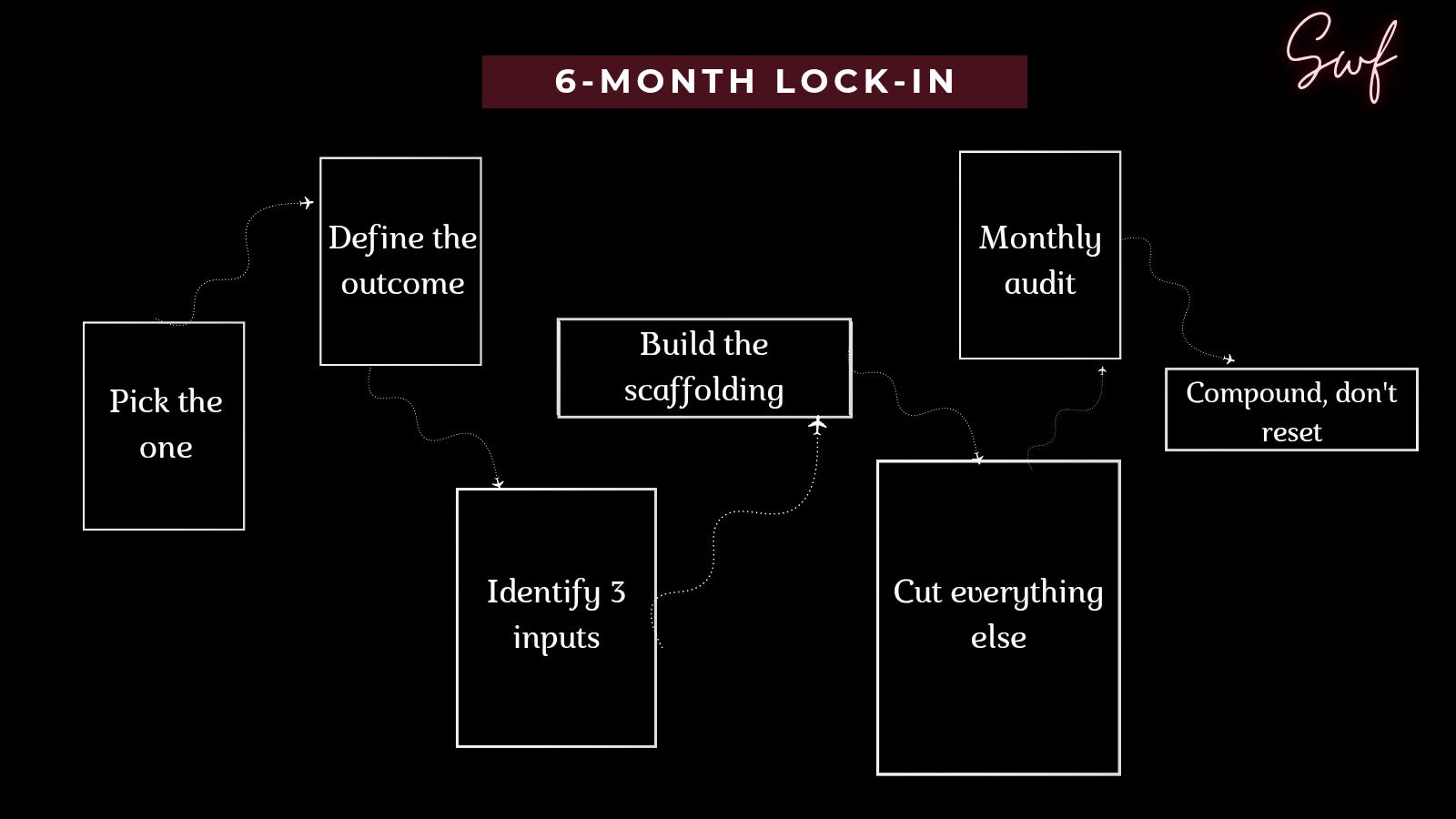
Step 1: Pick the one thing.
If you've read the Decision Paralysis Detox letter, you know the Bored, Broke, or Bothered test. Apply it. The one thing that survives all three, the thing you would still do if you were rich, the thing you would still do if you were bored, the thing that bothers you enough about the underlying problem to work on it for free — is the one to lock in around. Pick it. Don't deliberate longer than 24 hours. The lock-in is the point. The picking is just the entry door.
Step 2: Define the December outcome, or whatever month is six months from now.
Not a vague goal. A specific, measurable, embarrassing-if-you-miss-it outcome. By [month], I will have shipped X. By [month], I will have built Y to Z scale. By [month], I will have closed N clients at $X each. The specificity is the lock. Without a specific outcome, the lock-in becomes vibes. With one, it becomes a contract.
Step 3: Identify the 3 inputs that produce the outcome.
Three. Not 5. The three daily or weekly actions that, if done consistently, produce the outcome by month six. For most one-person business owners, these will be some version of: build the thing, sell the thing, track the thing. The specifics depend on your one thing.
Everything else is benched.
Step 4: Build the financial scaffolding.
This is the step nobody talks about, and it is the reason most lock-in fails. You cannot lock in for six months if your money is in chaos in the background. The financial anxiety will leak into every decision. You'll cut things you shouldn't cut to save money. You'll take on projects you shouldn't take on for cash flow. You'll burn out by month three because the underlying financial uncertainty is eating your nervous system in the background of your focus.
The lock-in requires a financial operating system underneath it. That's why I built THE MONEY AUDIT SYSTEM. It is the operational scaffolding that lets you focus on the one thing without the money chaos undermining you. Track every payment. Tracks & calculate your taxes. Calculate your real hourly rate. Know what you can afford to invest in the one thing. Know what your runway looks like. Know what the next six months can hold without forcing you back into a hedge.
Without this scaffolding, the lock-in becomes a willpower exercise. Willpower runs out by week six. Structure doesn't.
Step 5: Cut everything that competes with the three inputs.
This is the step that hurts.
You will cut subscriptions, commitments, side projects, relationships, time sinks, and small daily yeses that you've been carrying for years. Some of the cuts will be people. Some will be patterns with people. Some will be parts of yourself you've been keeping alive on life support, hoping they'd revive without honest attention.
The cuts hurt because they are honest. Cut them anyway. The first cut is the hardest. By the fifth cut, you stop hesitating.
Step 6: Run the monthly audit.
Once a month same day, same hour you sit down and audit. Did the three inputs happen? Did the outcome get closer? What's drifting? What's the next month's correction? Twenty minutes. The audit catches drift before it becomes failure.
The monthly audit is also where the financial scaffolding pays off. You're not just auditing the one thing. You're auditing whether the one thing is producing what your financial life needs it to produce. The numbers and the inputs sit together on the same page, once a month, by design.
Step 7: At month six, do not reset. Compound.
When six months from now arrives, whatever month that is you do not start over. You do not pick a new one thing from scratch. You take what the six months built and pick the next one thing that compounds on top of it. The first lock-in is the hardest. The second is easier. The fourth is automatic.
This is how people who lock in once become people who lock in forever. The lock-in stops being a project. It becomes the way you operate.
If you're locking in and you want the financial scaffolding to hold the six months together, that's what I built the MONEY AUDIT SYSTEM for. Two halves of one system, the Personal Money Audit and the Business Audit, designed for the way you and creators/soleprenuers actually earn. It's the operating layer underneath the your finances. The thing that catches drift in your numbers before drift becomes failure.
Lock in. Build the scaffolding. Compound.
Six months from now, you'll either be someone who proved that locking in works, or someone who proved that hedging doesn't.
The data lives in your calendar starting the day you decide it does.
—Jessica
About the pledge.
A pledge isn't a charge. It's a placeholder. You pick an amount you'd be willing to pay when the paid tier launches. Nothing leaves your account today. Nothing renews. You can cancel anytime before the launch, no questions.
What you get when you pledge: when the paid tier opens (a few months out), your pledge locks in your founding-member rate, the lowest price the paid tier will ever be offered at. Even if I raise the price later, you stay grandfathered in at the price you pledged. You also get first access to the paid letters, the new systems I'm building, and the spreadsheets and scripts that won't be available to free subscribers.
If that's useful to you, the pledge button is below. If it isn't, the free letters keep coming either way. Hit subscribe below and you'll see the option to pledge.
The line about exhaustion being the signal of dispersion, not progress, is uncomfortably accurate. I've mistaken being tired for being productive more times than I'd like to admit.
On January 1st, I planted my flag: "This is the year I finish and publish the novel." 12 years, 15 drafts, one vow.
And then my contract ended, and I had a gut check moment.
I'm still writing, still pursuing my goal. If anything, I have more time now, a window of opportunity at the very least, and I'm making the most of it while I can.
I reach my six month milestone this Wednesday.