


There is a specific pattern that keeps multi-potentialites stuck for years, and almost nobody names it.
The pattern is not that you cannot focus. Not that you lack discipline. Not that you are afraid of commitment. Every serious multipotentialite you know has enormous focus when the right thing finally lands. Focus is not the issue.
The issue is that you keep trying to pick between your interests instead of building on top of them.
Every three months you commit to one lane. Every three months a different interest starts pulling at you. Every three months you convince yourself you picked wrong and you pivot. The picking loop repeats until you look up and it has been five years and none of the interests turned into anything, and you are quietly certain the problem is you.
The problem is not you
The problem is that pick a niche was the answer to a career question that stopped applying five years ago. In the AI era, the specialist is the commodity. What compounds now is the combination. What almost nobody in your life has told you is that your multiple interests are not five separate careers you are bad at choosing between. They are components of one specific person. Yours. And the work of the next 1-2 years is not to pick which one gets to live. It is to build on top of the fact that you have all of them.
Before I go further, I want to reconcile something. Because a few weeks ago I wrote a letter called “You Have 6 Months To Lock The F*ck In”, and the surface reading of that letter is "pick one thing." The surface reading of this letter is "do not pick one thing." Those look contradictory. They are not.
Locking in is what you do with a goal. One project, one outcome, one direction to compound toward for six months. Combining is what you do with your interests. The raw material you bring to any goal. You still pick one goal at a time. You just stop trying to pick between the interests you bring to it.
Both letters point at the same operator. She picks one goal and combines all of her interests inside it. She locks in on one project at a time and refuses to fragment the person building it.
That is the operator this letter is trying to build.
What the picking loop actually costs
You already know it costs time. That is the surface cost.
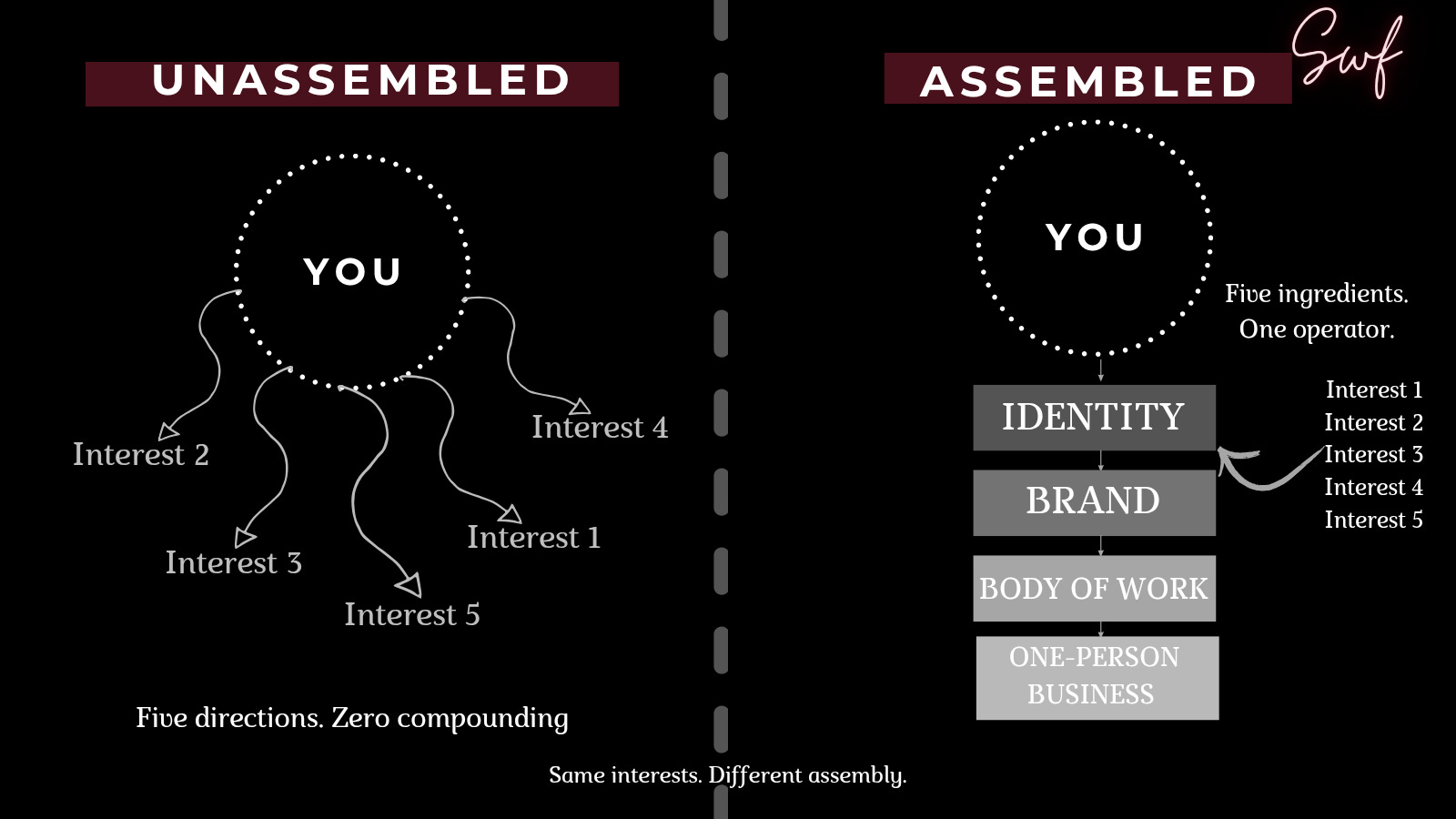
The deeper cost is that every time you pivot, the residue of the previous interest gets left behind. You spent months learning something. You built a small amount of skill, a small network, a small library of ideas, a small feel for the domain. Then you pivoted. And all of it went into a drawer, uncombined with anything else, waiting for a future you might never return to.
Multiply that by five interests over ten years. You now have five drawers full of half-built material, none of which is talking to any of the others, all of which is invisible from the outside, and all of which was pointing at the same thing the whole time — the specific work that only the combination of the five could produce.
That work has been possible the entire time. It has been waiting for you to stop treating your interests as competing career options and start treating them as raw material for one specific operation only you could run.
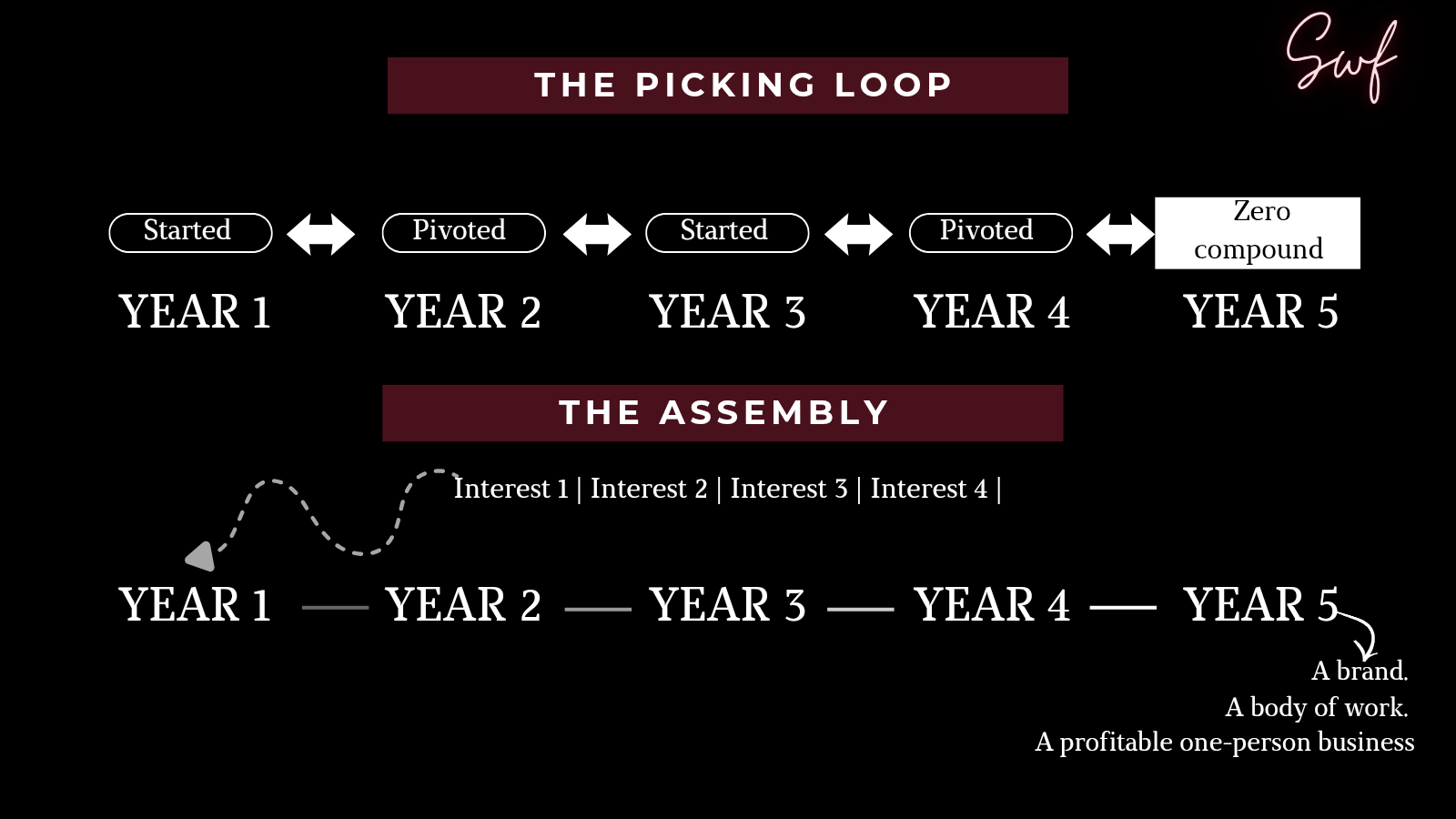
The picking loop is not just wasting your time. It is preventing your combination from becoming visible even to you.
You look at yourself and see five hobbies. You do not see the specific voice, the specific point of view, the specific offer, the specific body of work that lives at the intersection of the five. Nobody sees it. Not your family, not your friends, not the career coach who told you to niche down. Not you.
Which is why you keep trying to pick. Because from inside the picking loop, picking looks like the only rational move.
It is not. It is the least rational move you could make.
The rational move is to figure out what your five drawers of material actually add up to, and start building the specific thing they were meant to become.
The shape of who you become
Here is what the transformed version of you looks like from the outside.
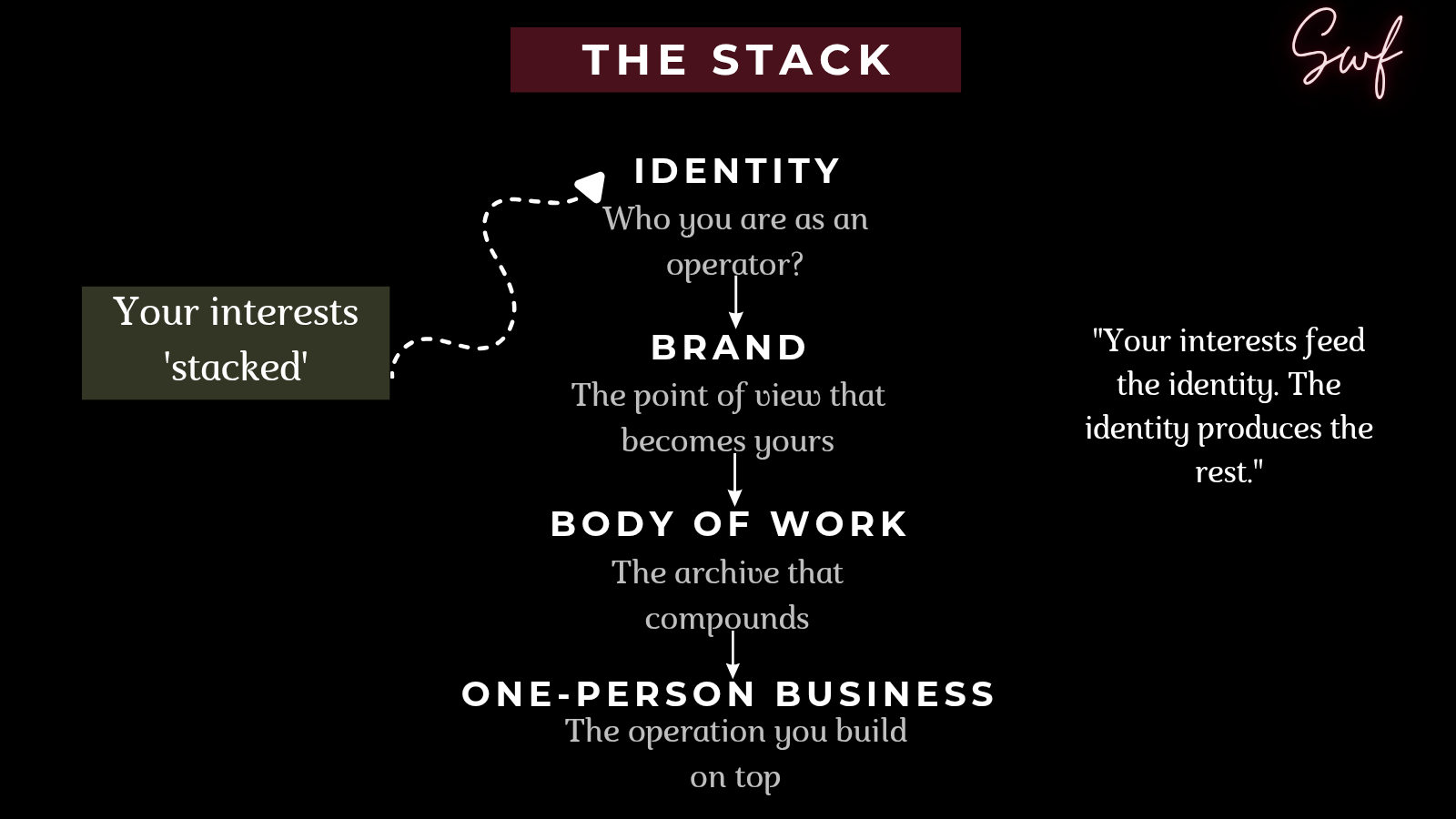
You have a brand. A specific point of view that people recognize as yours because it lives at an intersection nobody else occupies. Your brand is not "finance writer" or "business coach" or "creative." It is a specific combination of your interests that produces a specific voice that could not have come from any other person. That voice is defensible in an economy that has commoditize every individual skill.
You have a body of work. A public archive of writing, videos, essays, threads, or artifacts that documents your combination in motion over time. The archive compounds. Every new piece of content you publish builds on top of every previous piece. Five years in, the archive is undeniable. Ten years in, it is a permanent part of the internet.
You run a one-person business on top of the brand and the body of work. The business is not separate from the interests. It is the natural output of them. Products, offers, services, and systems that exist because your specific combination made them possible.
Underneath all three, you have an identity. Not a title. Not a niche. A coherent sense of who you are as an operator that ties the brand, the body of work, and the business into one thing. You do not introduce yourself as a finance writer or a coach or a creator. You introduce yourself as yourself, and the specific work you do becomes legible over time.
These four things do not exist in isolation, they STACK.
Identity produces the brand. The brand produces the body of work. The body of work produces the one-person business. And the one-person business, once running, reinforces the identity, because you have receipts for who you said you were.
That is the shape you are building toward. Not 3-5 separate careers you might pick between. One stacked operation with your name on it, that only you could have built.
Let me show you what this looks like when it is actually working.
What this looks like in practice
I want to use one of my own letters as the concrete example, because it is easier to point at something real than to describe the shape in the abstract.
I published a letter earlier called Why Six-Figure Founders Still Feel Broke & The most underrated skill in the creator economy (And it's not writing). It landed harder than almost anything else I have written. Readers messaged me for weeks about it. Some of them told me it was the first time anyone had put words to something they had been carrying quietly for years.
That letter is a concrete example of what combining interests looks like when it actually produces something.
The letter sits at the intersection of three of my interests. Finance — specifically the operational side of running a one-person business, which most personal finance writing ignores. Psychology — specifically the nervous-system layer underneath money, which most finance writing refuses to touch. And writing — as the medium that combines the other two into something readable.
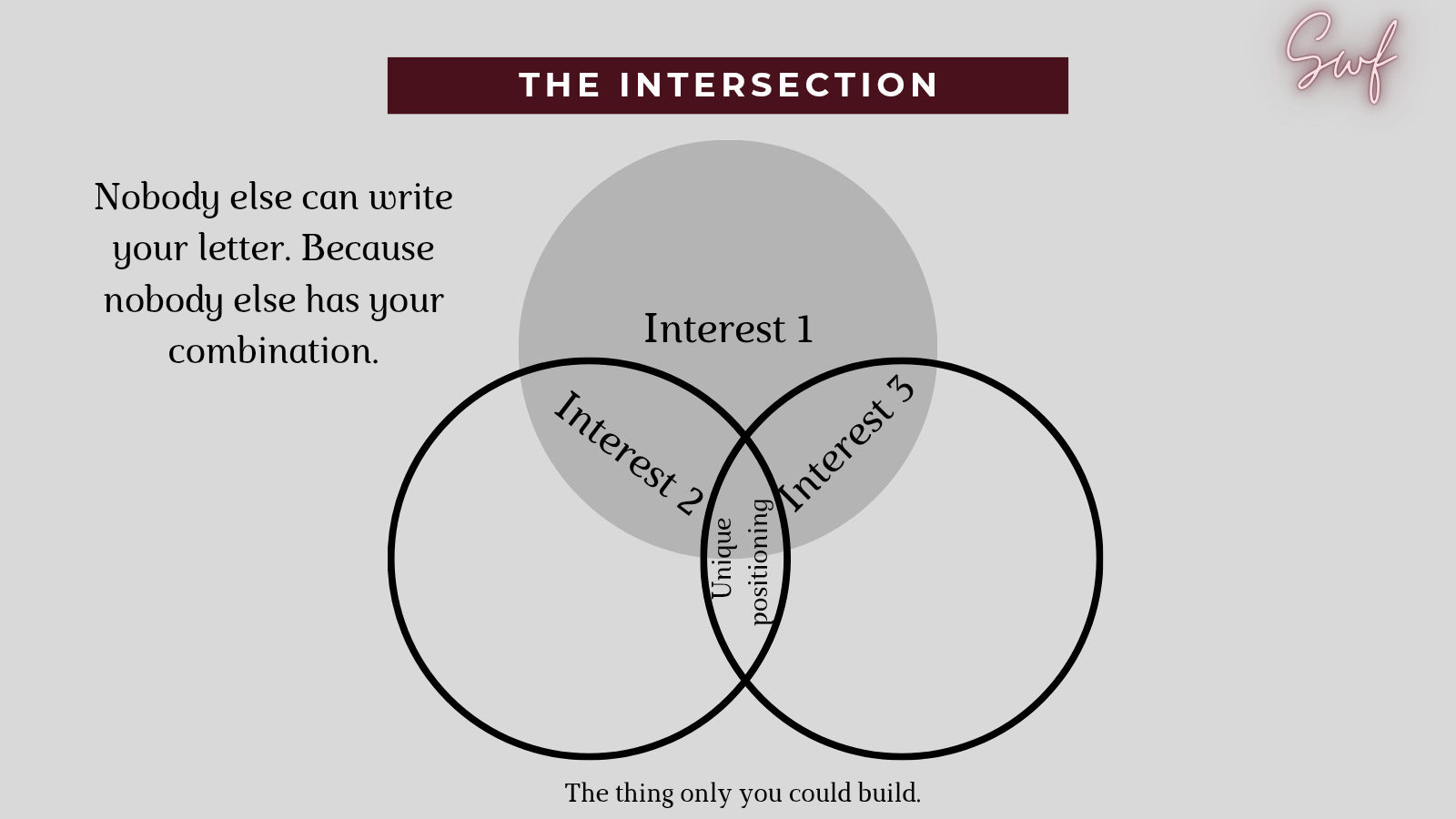
Nobody else in my space is writing that specific letter. Not because they cannot. Because they do not have my specific combination of interests. The finance writers are not psychologically curious enough. The psychology writers are not operationally rigorous enough. The business writers are not emotionally honest enough. The letter exists because my specific combination made it possible.
That letter is part of the body of work. The body of work reinforces the brand — which is not "finance writer," it is "someone who builds profitable one-person businesses in public with finance as the operational layer underneath." The brand supports the one-person business — which is Slaywithfinances plus the products I sell plus the paid tier coming next. And the identity underneath all of it is the version of me that stopped apologizing for being interested in finance and psychology and writing and businesses and slow living all at the same time, and started building on top of the whole combination.
The letter is not the thing. The letter is evidence. Evidence of what happens when the combination compounds instead of getting split five ways.
You have your own version of that letter. It is waiting for you to write it. Which requires the combination to become visible to you first.
Where to start
You cannot combine what you have not named.
Which sounds obvious and turns out to be the step that separates the people who eventually build from the people who spend another decade stuck in the picking loop.
The naming is where the shape becomes visible. Once you have written out every interest, obsession, skill, and thing-you-keep-coming-back-to, the combinations start to reveal themselves. Certain overlaps produce a pull, a small physical recognition when you say them out loud together. That pull is data. That is your combination trying to introduce itself.
Then the question changes.
You stop asking "which one should I pick?" You start asking "what does the person who has all of these actually build?" That question has an answer for you specifically. It is the answer nobody else can give you, because nobody else has your specific combination.
You cannot combine what you have not named.
Which sounds obvious and turns out to be the step that separates the people who eventually build from the people who spend another decade stuck in the picking loop.
The naming is where the shape becomes visible. Once you have written out every interest, obsession, skill, and thing-you-keep-coming-back-to, the combinations start to reveal themselves.
Subscribe to get The Interest Combination Workbook.
Free. It's how you turn the abstract "figure out your combination" into something concrete you can actually see. Plus one letter like this every week.