


Cutting costs will not save your business.
There, I said it.
I know that goes against every finance-for-business article you've read in the last two years. Trim the subscriptions. Cancel the coach. Downgrade the software. Renegotiate the contractor. Cut the marketing spend. It feels like control. It looks like discipline. It gives you something to do while the anxiety of running a business is eating you alive on a Tuesday night.
But here's what the data actually says.
82% of small business closures come from cash flow issues. Not lack of customers. Not bad products. Not competitors. Not the economy. Cash flow. Money leaking out of the business faster than it comes in, in ways the operator can't fully see or fully control, until one month it's too late to catch up.
Cash flow is a system problem. And you cannot cut your way out of a system problem. You can only build your way out of one.
That's what this letter is about.
Not because the personal finance industry needs another take on business — it doesn't. Because almost every solopreneur, freelancer, one-person business owner reading this has been fed the same defensive playbook: cut, save, tighten, survive. And most of them are still bleeding, quietly, in the exact ways the playbook was supposed to fix.
There are only two things that actually save a one-person business. Two levers.
Everything else is a distraction.
If you focus on these two, you don't have to cut. You don't have to panic. You don't have to spend Sunday nights running the math in your head, wondering if you should downgrade the coaching program or cancel the software you actually need.
Let me walk you through them.
If you want one letter like this every week, subscribe. I write the things the personal finance industry won't.
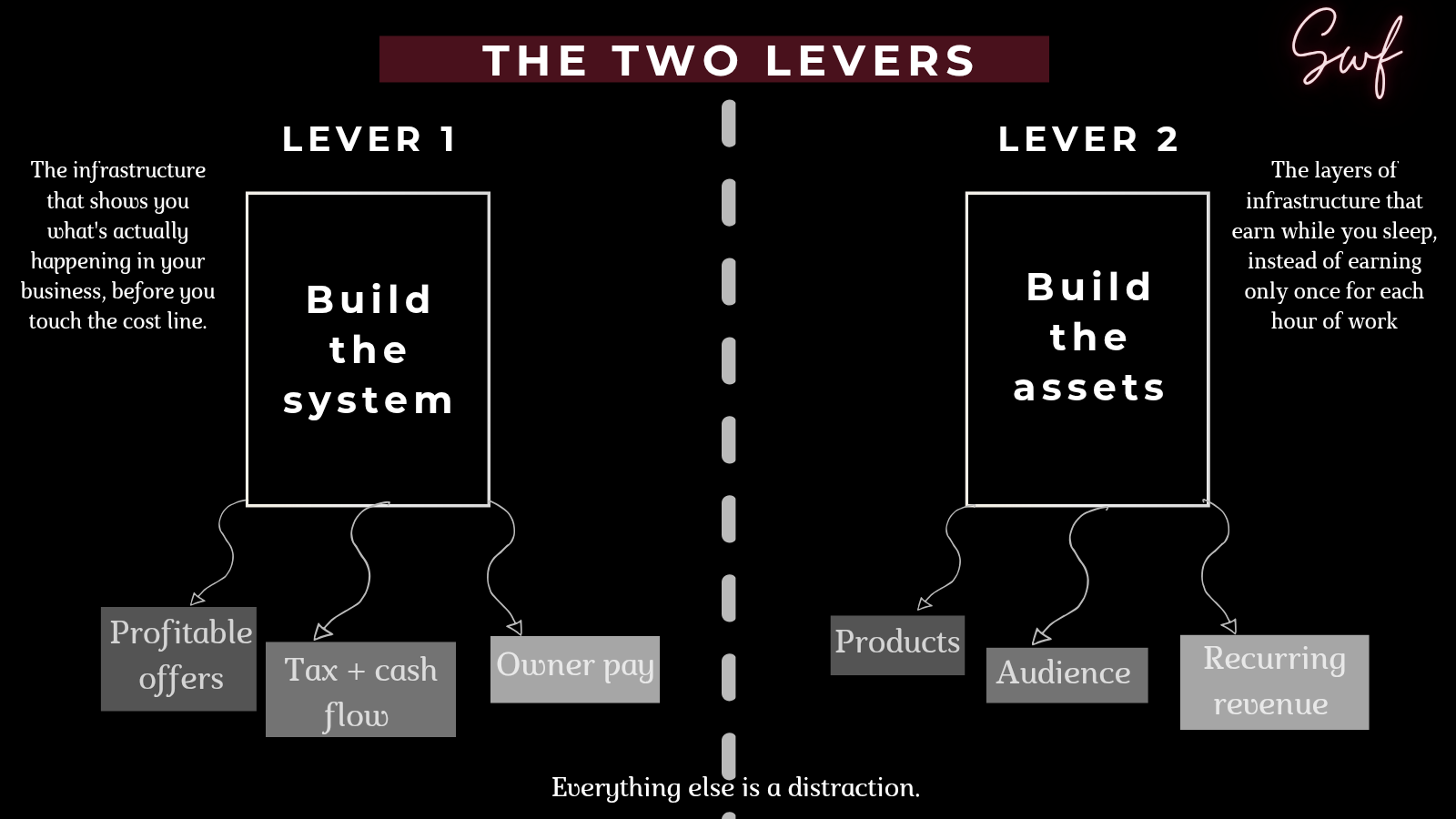
Lever one: build the operating system before you touch the cost line.
Here's what most solopreneur don't realize.
Cost-cutting is a reactive move on a business that requires proactive infrastructure to survive. When you cut expenses without first building the operating system underneath the business, you are solving the wrong problem. The leaks aren't in the expenses column. The leaks are in the system that decides where money goes, when it goes there, and whether anyone is watching.
Watch what happens when a business tries to cut its way to health without rebuilding the operating layer.
Peloton has spent the last four years in what is essentially a continuous cost-cutting exercise. In 2024, they laid off 15% of their global workforce — roughly 400 people — as part of a $200 million restructuring plan. Their CEO stepped down. They closed retail locations. They cut marketing spend, IT spend, contractor spend, software spend. Every category people tell you to cut, they cut.
Twelve months later, they announced another $100 million restructuring plan. Another 6% workforce reduction on top of the first one. As of February 2026, they've eliminated 11% of their workforce in this second round. Their membership base is still shrinking.
Three rounds of restructuring. Four years. Over 25% of their workforce eliminated. Hundreds of millions in expense reductions.
And the underlying business is still not healthy.
Because their problem was never the cost structure. Their problem was that they never rebuilt the operating model underneath a market that had changed. The system that decides how money moves through the business. Which customer to serve, at what price, through which offer, at what margin, was broken. Cutting expenses within a broken operating system doesn't fix the system. It just slows the rate at which the broken system consumes capital.

Same thing happens to solopreneur at smaller scale, quietly, every week.
You cancel the coaching program because "money is tight." Money is still tight next month. You downgrade the software because you're trying to save $47/month. Your revenue doesn't grow. You trim the contractor hours because you're worried about the tax bill. The tax bill still shows up. You've been cutting for eighteen months. You still cannot pay yourself a real salary. You still cannot tell someone with confidence what your real profit margin is. You still cannot sleep on Sunday nights.
The cutting isn't working. Because the cutting was never the problem.
What you need is an operating system that tells you what's actually happening in your business, at any given moment, without you having to hold it all in your head.
This is what a real one-person business operating system does. It shows you which of your offers is actually profitable, not which one feels profitable. It tells you your real hourly rate. It calculates what you owe in tax before the bill arrives. It tells you how much of every deposit is actually yours to keep and how much belongs to future obligations. It tells you when you can safely pay yourself and how much. It tells you if the "good month" was actually good, or just noisy.
Without that system, every financial decision is a guess. Cut this. Save that. Downgrade the other thing. All done in the fog of not knowing what's actually working.
With that system, cutting mostly becomes unnecessary, because you can see which parts of the business are genuinely worth their cost, and which parts are quietly bleeding money you didn't know about. The leaks show up. The waste gets named. The parts that are actually compounding get more resources, not less.
If you want a version of this you can use without building it from scratch, the BUSINESS MONEY AUDIT SYSTEM is what I built for exactly this reason. Twelve tabs, one dashboard, designed for the way solopreneur actually earn. Lumpy income, multiple revenue streams, platform fees, late invoices, taxes that don't behave. It runs on your real numbers. It's what I use for myself. It's what I hand to anyone who tells me they've been cutting for months and still cannot see what's happening in their own business.
The system is the lever. The cutting is the distraction.
Onto the second lever.
Lever two: build the assets that compound, not the ones that just survive.
Here's the second thing most solopreneur don't see.
Every hour of your work is an investment. It can produce something that earns once — one client project, one launch, one paid gig. Or it can produce something that earns repeatedly — a product that sells while you sleep, a system that runs without you, an asset that compounds. Most soloprenuers are stuck in the first category. Because the first category feels like doing the work. The second category feels like taking a bet.
You're playing the wrong game.
If your business is built entirely on earn-once activities, you will always be running to stand still. Every month starts at zero. Every income drop is a threat to the entire operation. Every client who leaves takes with them a proportional slice of your survival. And when the anxiety hits, the only tool you have left is cutting expenses, because you cannot cut yourself.
Meanwhile, the solopreneur who look like they've broken the pattern — the ones who seem to have unlimited runway, absurd margins, and no visible stress about the next month — did not get there by cutting harder.
They got there by building assets that compound.
Look at Justin Welsh. A former SaaS sales executive who burned out in 2019, left the corporate track, and built a one-person business from scratch. As of 2025, his business generates over $4 million a year in revenue with no employees — one part-time virtual assistant handling customer support, and that's it. His cumulative lifetime revenue has crossed $12.5 million, at margins most ten-person agencies could never touch.
– He did not build that business by aggressively cutting expenses.
– He built it by systematically constructing a compounding stack of assets.
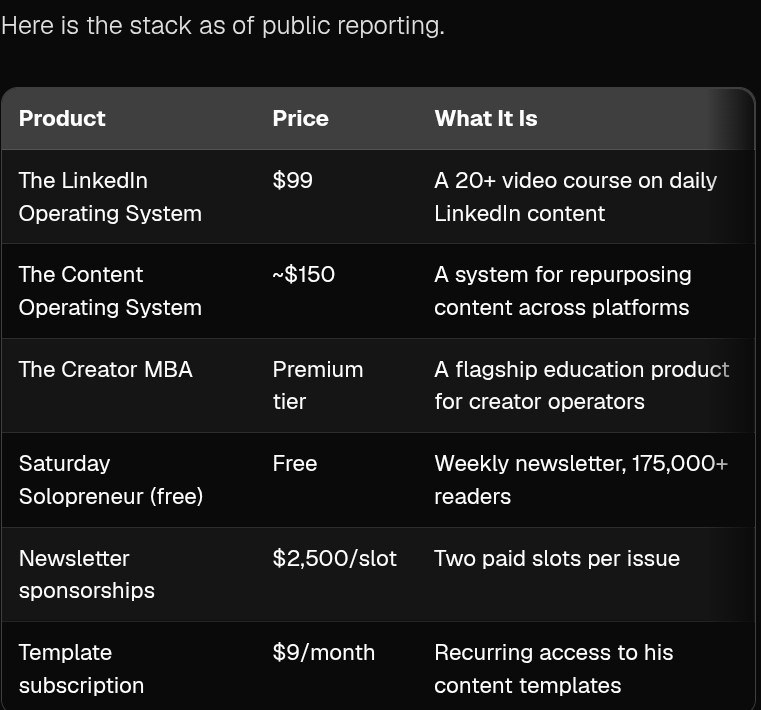
– Here's what the stack actually looks like:
– He writes one LinkedIn post a day. Has done that for six years. That's the daily content system, the free asset that keeps growing the audience without additional cost per post.
The LinkedIn audience feeds his newsletter. The Saturday Solopreneur, now at 200,000+ subscribers. That's the second asset. Every new subscriber compounds on the audience he already had. And because he owns the email list, the platform algorithm cannot take it from him overnight.
The newsletter sells two flagship courses. $150-$300 each. Tens of thousands of seats sold. That's the third layer; a product that earns while he sleeps. He doesn't have to be there for someone to buy it. The course was built once and sells forever.
He also runs a paid template subscription — a small monthly recurring revenue product that compounds every month without him doing additional work.
Each layer feeds the layer above and below it. The audience feeds the newsletter, the newsletter sells the courses, the courses build authority which grows the audience faster. And every single layer of the stack was built, not cut. Every single one required an investment of time, thought, and often money, before it started paying back.
If Justin Welsh had spent the last six years cutting his expenses instead of building his stack, he would still be a solo LinkedIn writer with 400 followers and a coaching side hustle. He would not have a $4M business.
The difference between him and every soloprenuers I know who is quietly stuck at $50K a year is not talent. It's not luck. It's not connections.
It's that he treated every hour of his work as an investment into an asset that would keep earning, while most soloprenuers are treating their hours as time-for-money trades that stop earning the moment the hour ends.
Now, here is what this actually means for you.
You do not have to build what Justin Welsh built. You do not have to be at $4M. That's not the point. The point is the shape of what he did. And it applies at any income level.
• If you are a service provider, the compounding move is turning your service into a productized offer that runs with less of your time each month.
• If you are a coach or consultant, the compounding move is turning your knowledge into a paid group program or a course that scales the delivery.
• If you are a freelancer, the compounding move is building an audience or a paid list that produces demand without cold outreach.
• If you are a creator, the compounding move is building the paid product ladder that turns your audience into recurring revenue.
Every one of these moves is a build move. Not a cut move. And every one of these moves shifts the underlying math of your business from survival to compounding.
Which is the only real fix.
Before I go.
I'm building a live 5-day workshop based on everything I've written about here, the operating system layer, the compounding assets layer, and how the two work together. Where we fix this in real time, on your actual numbers, with feedback. Not another course to add to a library of unopened courses. Actual implementation.
I want to know what would matter most to you before I build it.
Reply with what fits, or use the poll below. I'll build what you actually need.
Two levers. Everything else is a distraction.
Build the operating system that shows you what's actually happening in your business. Build the compounding assets that let your work earn more than once.
If you focus on these two, the cutting problem solves itself. The leaks get named because the system finally sees them. The revenue grows because the assets keep working while you sleep. The tightness that has been sitting in your body for months slowly starts to quiet.
Not because you cut your way there.
Because you built.
— Jessica

Subscribe and the Profitable Creator Calculator will land in your inbox. It's the free tool I built to help soloprenuers and creators map their numbers the way this letter is talking about.
Cutting costs can improve short-term margins, but it rarely fixes a weak value proposition; the real constraint is often demand, not expense.
What looks like efficiency in one quarter can become capacity loss in the next, which raises a harder question: are costs being removed, or are future growth options being quietly eliminated?
Your argument that cost-cutting is often mistaken for strategy highlights an important distinction between improving financial metrics and strengthening the underlying engine of value creation.
In that sense, the real question is not whether a business can become leaner, but whether its allocation of resources is increasing or diminishing its capacity to create value over time.
An important point. Cost-cutting alone rarely solves cash flow challenges. Strong financial systems and better visibility into how money moves through the business usually have a much bigger long-term impact.