


Most of the creators you think are winning are not spending the way you think.
The feed shows the brand trips, the PR hauls, the studio day, the four coffee runs, the aesthetic second phone. The feed does not show the monthly subscription audit, the editor they renegotiated with twice this year, the business expense they refused to approve for themselves, or the quiet decision to not scale past a certain revenue number because scaling further would cost them their life.
The visible version of creator wealth is the smallest, loudest part of it. The real version is what they do with the money when nobody is filming.
Two recent clips stuck with me on this.
On the Moneywise podcast, Ali Abdaal, running a $6M/year creator business, net worth somewhere between $7M and $15M…went on record saying his real target is $2M a year in profit so he can work when he wants, on what he wants. He has explicitly refused to scale further. His stated personal luxuries are flying business class and not having to take out the trash. That is the list. His rule: "Freedom comes from leaving money on the table."
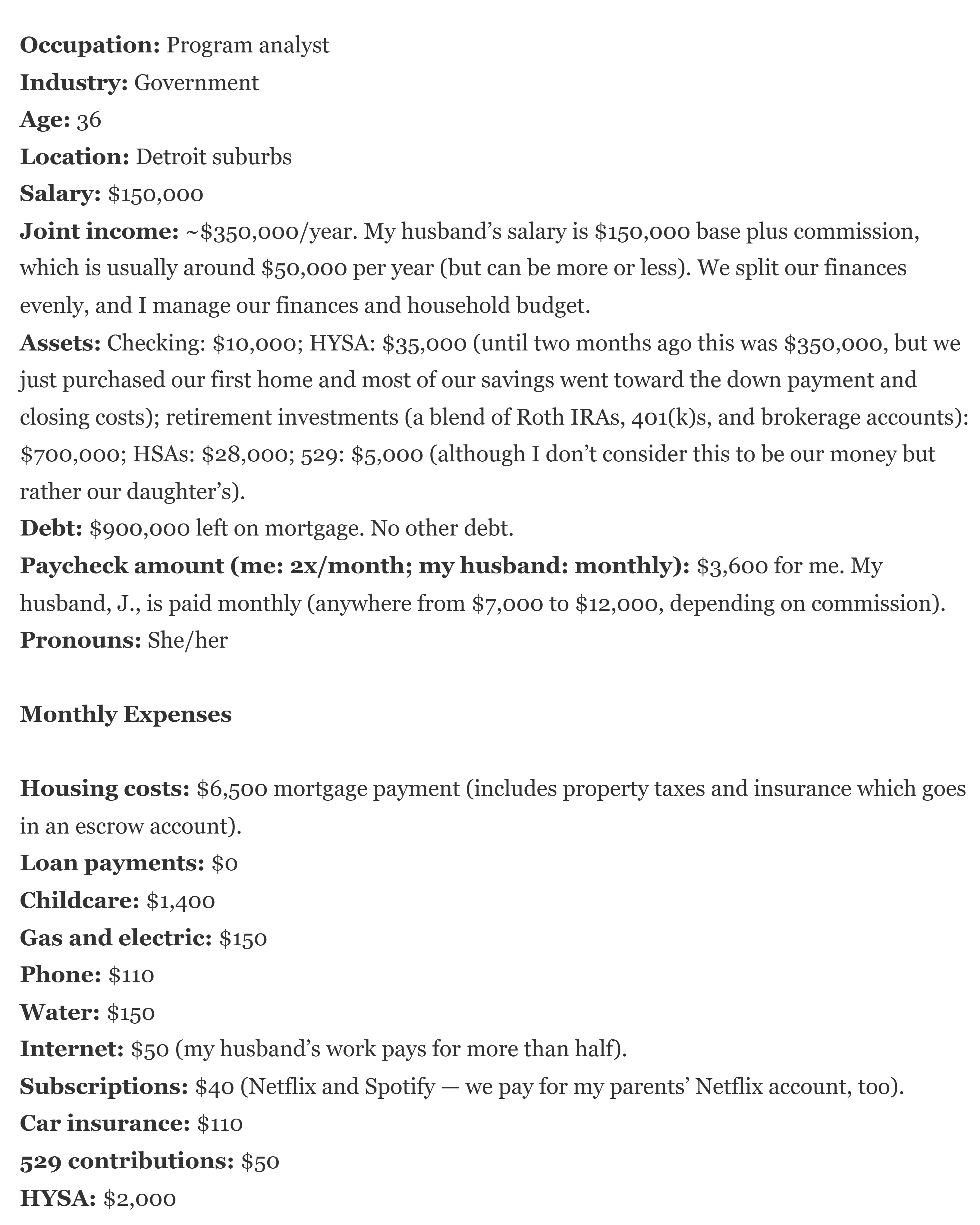
On X earlier this year, Codie Sanchez, net worth around $20M…broke down a couple earning $350K a year combined with $2K left at the end of each month. Her diagnosis: "People build their life up to their income instead of prioritizing living way below their means." Her own lifestyle she describes as "basic but mighty." No status cars. No optics spend. All the money quietly deployed into the next boring business.
Neither of them is hiding it. They are both saying the quiet part out loud. Almost no one else in the creator economy is.
So I want to talk about why.
Hat tip to Mia McGrath at Frugal Chic®, who wrote a brilliant version of this argument about influencers more broadly a few weeks ago. This is the creator economy translation of her idea
What the feed shows is almost never what they spend
A lot of what you see in a creator's day-to-day was gifted, written off, or bought specifically for the shoot. If you are a lifestyle creator, the camera, the outfit, the trip, and the dinner are part of the production budget, the same way a laptop is for a writer or a studio is for a musician.
The designer bag in the morning vlog tells you almost nothing about what the creator buys on an ordinary Sunday afternoon when nothing is being filmed.
Which means the version of their life you are measuring yours against is not their life. It is their set.
Frugal does not mean small
The word "frugal" has been doing bad PR for itself for years. It sounds like a scarcity move…cutting back, saying no, playing small.
For the creators who actually last, frugality is a different thing. It is selectivity. Where does the money go? Into what earns something back. Where does the money not go? Into what only looks like it earns something back.
Ali does not drive a nice car. He pays his team well, invests in the systems that run the business, and keeps his personal lifestyle small enough that the business never has to subsidize his ego. Codie does not run her life out of her media company's revenue, she runs the media company to feed the holding company that owns real assets. Both of them spend a lot. On infrastructure. Almost nothing on optics.
The creators who will still be here in 2030 already built their money this way. They know which category every dollar falls into before they spend it…wether a starting creator, in the middle or wherever they see themselves, because they built the audit infrastructure to see it clearly. The ones who will not be here are the ones currently expanding their life as fast as the brand grows, because they have no system that catches the drift until tax season does.
Pay for infrastructure. Underpay for optics.
Frugality matters more, not less, when the money arrives
Most people assume frugality is a starter habit. Useful when you had nothing. Something to outgrow once the income scales.
The creators who stay solvent long enough to build real wealth do the opposite. The discipline sharpens as the money arrives, because the gap between what the business earns and what they spend is the only place actual wealth gets built.
Codie's whole critique of high-earning professionals is that they expand their life the second their income does. $350K a year and $2K in monthly savings is not a money problem. It is more like a discipline problem that got invisible expensive very fast.
Creators get there faster than almost anyone, because the income can scale quickly and the lifestyle gets packaged as part of the brand. The bigger house, the better car, the studio upgrade, the new office…each one framed as "I earned this," none of them audited for whether it actually earns anything back.
Goldman Sachs' 2026 retirement survey found that 36% of Americans earning over $300K are still living paycheck to paycheck. The number is bigger for creators, because almost nobody is watching the back-end for us. There is no HR team, no corporate finance oversight, no boss asking where the money went. It is just you, the Stripe dashboard, and whatever audit system you built before the money got loud. If you did not build one, there is nothing catching the drift. The money just leaves, politely, through forty small subscriptions and twelve rounded up guesses, and by the new month you cannot name where it went.
The creators who last are the ones who built the discipline first, and let the income catch up to it, not the other way around.
Three things to take into your own creator spending
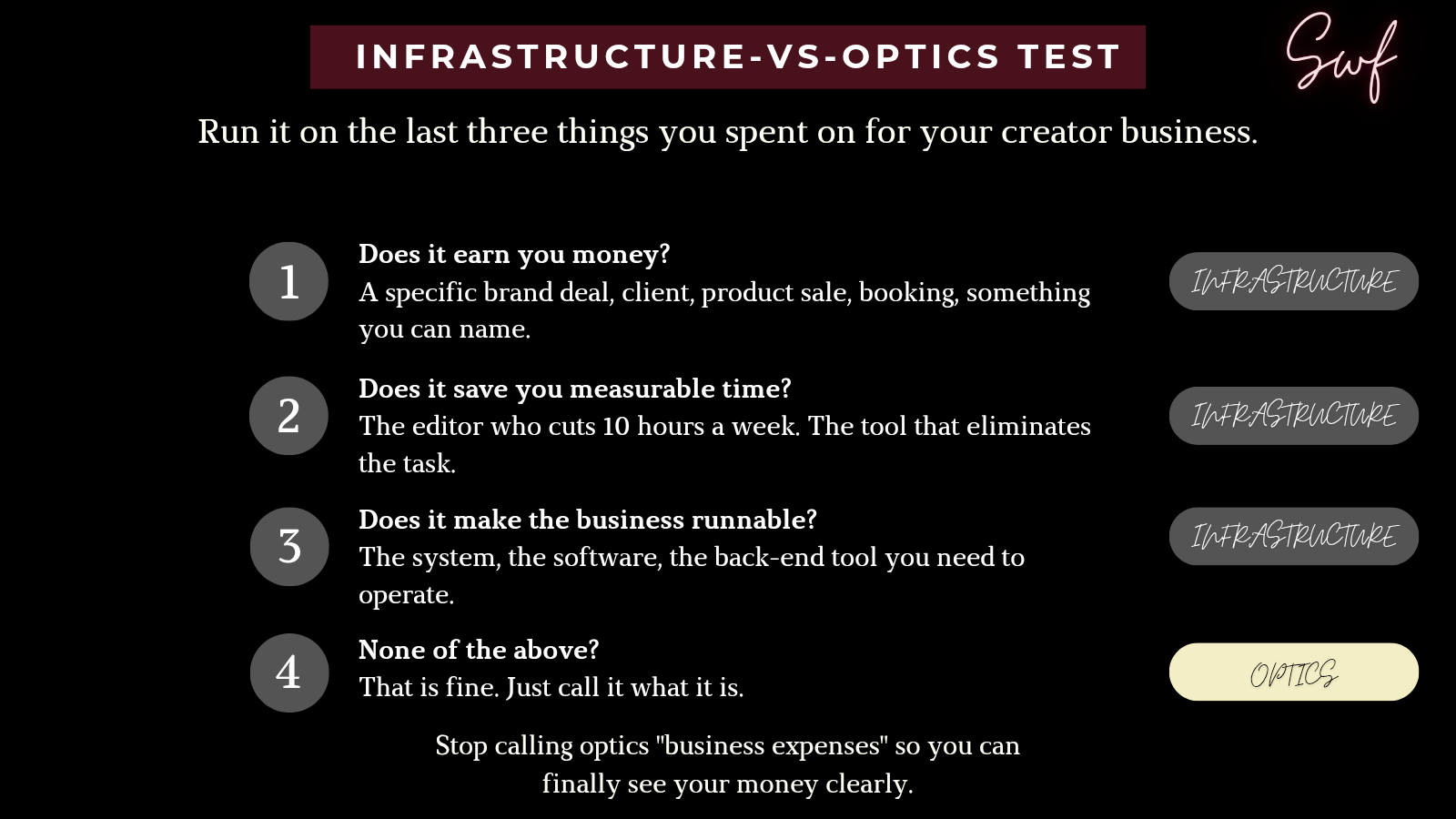
Call it what it is. If a purchase is not making the business runnable or generating income you can specifically name, it is a lifestyle expense. That is completely fine. The problem is calling a lifestyle expense a "business investment" and losing the ability to see your own money clearly.
Build the business before you perform the business. A lot of creators spend to look like they have made it before they have actually built anything underneath. That is how most creators burn out before few years in, the lifestyle got expensive faster than the revenue got stable.
Build the audit before you need it. The creators who catch their own money leaks early are the ones running a system that forces them to look. "I'll check in January." A specific repeatable audit that runs on a schedule, so the infrastructure vs optics check happens automatically instead of whenever the panic arrives.
This week, do one thing (and then the thing underneath it)
Pull up the last three things you spent on for your creator business over $50.
Write infrastructure or optics next to each one.
To count as infrastructure, the purchase has to make the business runnable, save you measurable time, or generate income you can specifically name. If you cannot name the return, it is optics. And that is okay, not every purchase has to earn.
But three purchases is a diagnostic. If you do the exercise and your gut already tells you half of them are optics, that is the evidence that you need the full version of this, not the one week version. The Audit System is what turns this exercise into infrastructure of its own, the specific system that runs the infrastructure vs optics check across every account you have, every subscription you forgot about, every pricing decision you have been avoiding, and every business expense you have been calling an "investment" because it felt better than calling it what it is. Money Audit System Bundle (personal + business)
For creators who want to actually run the audit the lasting creators are running. Not just label three purchases this week and forget by next Friday.
The creators who look like they have it all are usually the ones being most careful about what they do not buy.
— Jessica xx
Credit where it is due: this letter was inspired by Mia McGrath's piece at Frugal Chic® on the same pattern, but about influencers broadly. If you liked this, read hers…she is one of the sharpest money writers on Substack right now.
P.S. The letter you just read is the free version of how I think about creator money. The paid tier is the infrastructure underneath it, the Profitable Creator Launchpad for brand clarity, every mini-product I release as it drops, the Q&A Panel where I answer what I don't answer anywhere else, the Behind The Build Podcast, and the full archive.


Want to go deeper? Here is how I can help.
A few ways to work with me or support the work:
The Business Money Audit System: the full twelve tab system I use to run the finances of my own one-person business.
The Personal Money Audit System: the personal side version. Separate from the business, built to work alongside it, designed to run in about twenty minutes once set up.
Get your product or service in front of my audience through a sponsored newsletter. Reach out here.
The Money Paycheck Redesign: Insider Edition. Paid monthly and annual subscribers can submit their situation and I walk through a full paycheck redesign in a dedicated letter.
The Exact Money Review I Run On Myself Every Month (Personal life + Business)

For a long time I did money in my head.
I Redesigned 4 Strangers' paychecks. Then I Built the Tool I Was Missing the Entire Time

Over the last 30 days, 4 strangers sent me their entire financial lives. Every dollar. Every debt. Every savings account. Every subscription. Every secret.
The Most Underrated Skill In The Creator Economy (And It Isn't Writing)

A note before we start. This letter is completely free. I'm a real believer in financial transparency in this industry, and the whole argument I'm about to make is that the creator economy quietly hides the conversation we need to be having. So no paywall on this one. No upgrade prompts. No gatekeeping. Read it. Send it to the friend who needs it. If yo…
Yup, if you don't address the subconscious beliefs that are leading you to overspend and try to keep up with the Joneses, you will never make enough to truly feel free. Because there's always another expensive car or bag that's just outside of your reach. You gotta get ok with the internal dialogue first.
Great article! I’ve coached service-based businesses for years, and a common battle cry is, “It’s deductible!” I love your questions to help people see if an expense really does make sense. I say over and over again, it does not matter what you make, it matters what you keep! I've seen million dollar revenue businesses who take home nothing and $250k revenue businesses who take home plenty.