


I was at a coffee shop last week and I watched a woman pay for her drink.
Nothing about her stood out. Late thirties, jeans, a sweater that had been washed enough times to soften around the cuffs. She ordered. She handed over her card. She tapped, smiled at the barista, walked to the window seat.
What I noticed wasn't what she did. It was what she didn't do.
She didn't check her bank app after the tap. She didn't look at the screen on the card reader. She didn't run a small audit in her head about whether the latte was justified. She didn't make a joke about how expensive coffee had gotten. She didn't reference money in the seven minutes I watched her, including when she ordered a second drink later.
I have been thinking about her since.
Because I have run that audit. I have made that joke. I have, more times than I want to admit, watched the card reader to make sure the transaction would go through. And the gap between her relationship with a $14 coffee and mine, at a moment in my life when I objectively can afford the coffee, felt like the whole question.
What is that, that she has and I don't always?
I want to give you the line I've landed on, even though it took me months to land on it, and even though I expect to revise it again.
Wealth is not what you have. It's what you've stopped negotiating with.
Hold that for a second.
Most of us think wealth is the number in the account. The car. The house. The savings rate. The portfolio. And those things matter, I'm not arguing they don't but I've watched enough people now to know that they aren't the thing. I've watched people with all of it still flinch when the bank text comes in. I've watched people with very little of it stand in a room with the quietness everyone else in the room is reaching for.
The thing isn't the amount. The thing is what you've stopped negotiating with inside your own head.
I want to wander a bit, because every time I try to land this cleanly it slips.
Sometimes I think wealth is freedom. The ability to walk away from anything I don't want. The ability to say no without a calculation underneath the no. That feels true on some days.
Other days I look at someone with all the freedom in the world and notice they're miserable, and I think wealth must be something else.
Sometimes I think wealth is optionality. The number of doors I can open at any moment. Career doors. City doors. Lifestyle doors. The wealthier you are, the more doors are technically available to you.
But I've watched someone with twenty doors open spend a decade unable to walk through any of them, and I'm not sure all those doors made her wealthy. They made her paralyzed.
Sometimes I think wealth is time. The hours you own outright. The hours that don't belong to anyone else.
But I've watched people with all the time in the world spend it scrolling, anxious, drifting. Time without something to do with it is not wealth. It's just empty space.
Every definition I try lasts about three days before I watch someone embody it and look unhappy, and I have to revise.
What I keep coming back to is the negotiation.
The negotiation is the labor almost nobody names. The silent ongoing audit. Should I have ordered that. Was that necessary. Can I afford this. What's left after this. What does that put my month at. Am I going to regret this. The negotiation runs in the background of every transaction, every dinner, every Uber, every Sunday-night audit of all the things you should have done by now.
The wealthy aren't doing math you aren't doing. They're not negotiating math you're still negotiating.
The math is the same. The negotiation is different. The wealthy have built something, ‘a system, a number, a decision made months ago’, that closed the negotiation before the transaction ever happened. They walk into the coffee shop already done with the conversation about the coffee.
The not-wealthy are still in the conversation. Sometimes the conversation is louder than the coffee itself.
This isn't a moral gap. It isn't a discipline gap. It's a negotiation gap. And the negotiation gap is exhausting in a way nobody talks about, because the labor is invisible.
"The highest form of wealth is the ability to wake up every morning and say, I can do whatever I want today." (Morgan Housel)
Everyone stops there. It's the line that gets shared. It's the line that gets framed on Instagram.
But the line underneath that line, the one Housel doesn't quite write, is the harder one. Because waking up and being able to say I can do whatever I want today is downstream of something. It is downstream of having stopped negotiating, internally, with the question of whether you can. The question isn't asked anymore. The negotiation is closed.
Wealth, the way I think about it now, is the closing of the negotiation.
You can be earning $40,000 a year and have closed most of your negotiations. You can be earning $400,000 a year and still be negotiating, with yourself, in private, at every transaction.
The amount is not the variable. The closure is.
This is what the woman in the coffee shop had. Not a number. A closed conversation. She wasn't asking herself if the coffee was okay because she'd already answered that question for herself, in a system, weeks before she walked in. The system had done the work. She just walked through it.
I want to be careful here, because the closed conversation isn't gifted. It isn't class. It isn't bred. It's built.
You build a closed conversation about your money the same way you'd build one about your time. You decide, in advance, what counts as a yes. You decide, in advance, what the rules are. You decide, in advance, what's in the budget, what isn't, what gets routed where, what your floor is, what your ceiling is. Then you stop asking yourself the question. The system asks the question on your behalf. You just live.
That's the part nobody is selling, because it isn't sexy.
Closing the negotiation is not a 30-day challenge. It is not a course. It is not five tips. It is a slow, unglamorous building of structure underneath your life, so that the questions you're carrying in your head get to live somewhere other than your head.
The audit doesn't end. The audit moves out of you. Into something that runs in the background. Which is a different thing than what most people think wealth is.
Most people think wealth is the answer. It isn't. It's the system that has stopped asking you the question.
If this letter has done its work, here's what should change for you.
The next time you tap your card and your shoulders rise, you'll know what the rising is. It isn't a verdict on whether you're doing okay. It's the negotiation, still happening, in real time, inside your nervous system, because the system underneath you hasn't been built yet. Not because you're failing. Because the closure hasn't happened yet.
The work isn't to feel less. The work is to build the thing that closes the negotiation on your behalf, so that one day you walk into a coffee shop, tap a card, and the conversation in your head simply doesn't happen.
That is the day you'll know what wealth has actually meant the whole time.
Wealth is not what you have. It's what you've stopped negotiating with.
The numbers are downstream of the closure. The freedom is downstream of the closure. The quietness in the room is downstream of the closure.
The closure is the thing.
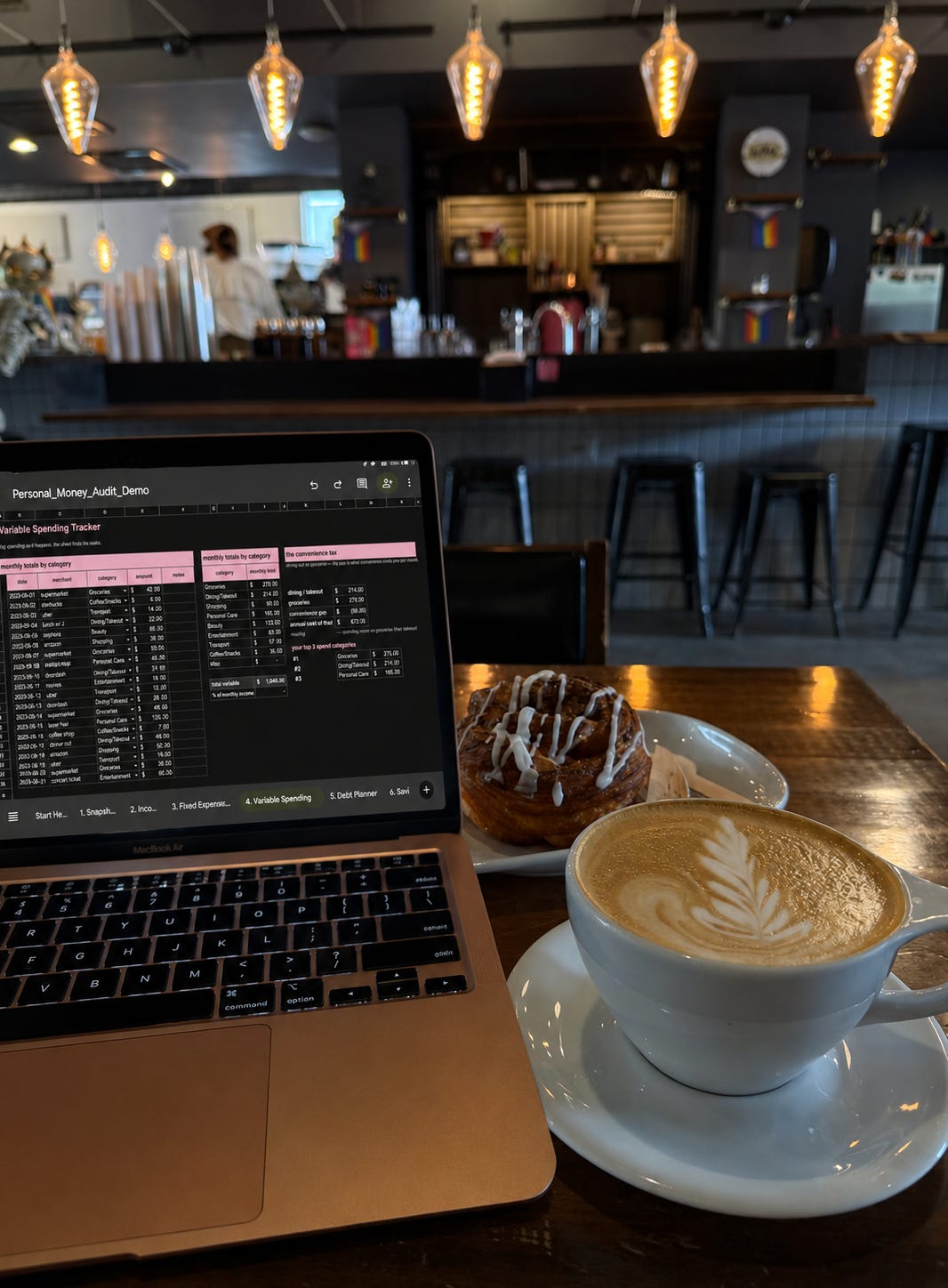
I built THE PERSONAL MONEY AUDIT for the very first step of closing the conversation, the one most people never get past because they've never had a place to put the math. It's not the wealth. It's the door the wealth walks in through. Once the math has a place to live that isn't your head, the negotiation can start to close.
The rest of it is yours.
—Jessica
This publication for people building a profitable one-person business. Finance as the operational system underneath. Frameworks, systems, and the kind of honesty the creator economy is too busy selling courses to say out loud.
The negotiation gap framing is sharper than the usual 'mindset vs. money' divide — it's not about discipline, it's about whether the decision already happened somewhere upstream. That distinction alone reframes a lot of my own spending friction.
True wealth is honestly mental peace! And that can only come through clarity.