


I woke up to a blank screen!
No warning. No email. No appeal window. Meta permanently disabled my Instagram and Threads accounts on the same day. 55,000+ followers across three platforms including Pinterest, over 10 million monthly views. Gone before I planned my day.
And here's the part that surprised even me. I checked my revenue that week. Then the next week. Then the month after. The number didn't drop. Not meaningfully. Not in the way anyone would expect when the entire top of their funnel disappears overnight.
My DMs were full of people saying "I'm so sorry you had to go through this, you can definitely start over again." My bank account didn't know anything had happened.
That moment made something visible that I'd been building toward for over a year but had never named. The reason my income survived had nothing to do with content, audience size, or platform loyalty. It survived because I had built financial infrastructure underneath the business before I ever needed it to hold weight.
Most creators build revenue on top of attention. I had built revenue on top of a system. When the attention disappeared, the system kept running.
This letter is about that system.
The Problem Nobody Talks About
Here's what I see constantly in the creator and solopreneurs space. People making money with no infrastructure underneath it.
Revenue comes in, revenue goes out. Good months feel like wins. Bad months feel like emergencies. Tax season is a scramble. Personal money and business money live in the same account, sometimes the same mental category. Growth looks like "make more" and security looks like "hope nothing breaks."
That's not a business. That's a high-effort lottery ticket.
And personal finance advice doesn't fix it either because it's built for people with salaries. Consistent income. Employer-matched retirement accounts. Predictable tax withholding. None of that applies to someone whose income changes every month based on what they launched, what landed, and what a platform decided to do with their reach.
What's needed is a financial system designed for variable income, split across personal and business money, that works whether the month is a $12,000 launch or a $400 quiet stretch.
I built one. I run it on every dollar I earn. And it breaks down into four stages.
The Infrastructure Method
Four stages. Two tracks running through each one simultaneously. Personal and business. Because for a one-person business, personal financial health and business financial health are the same system. Pretending they're separate is how someone ends up profitable on paper and broke in practice.
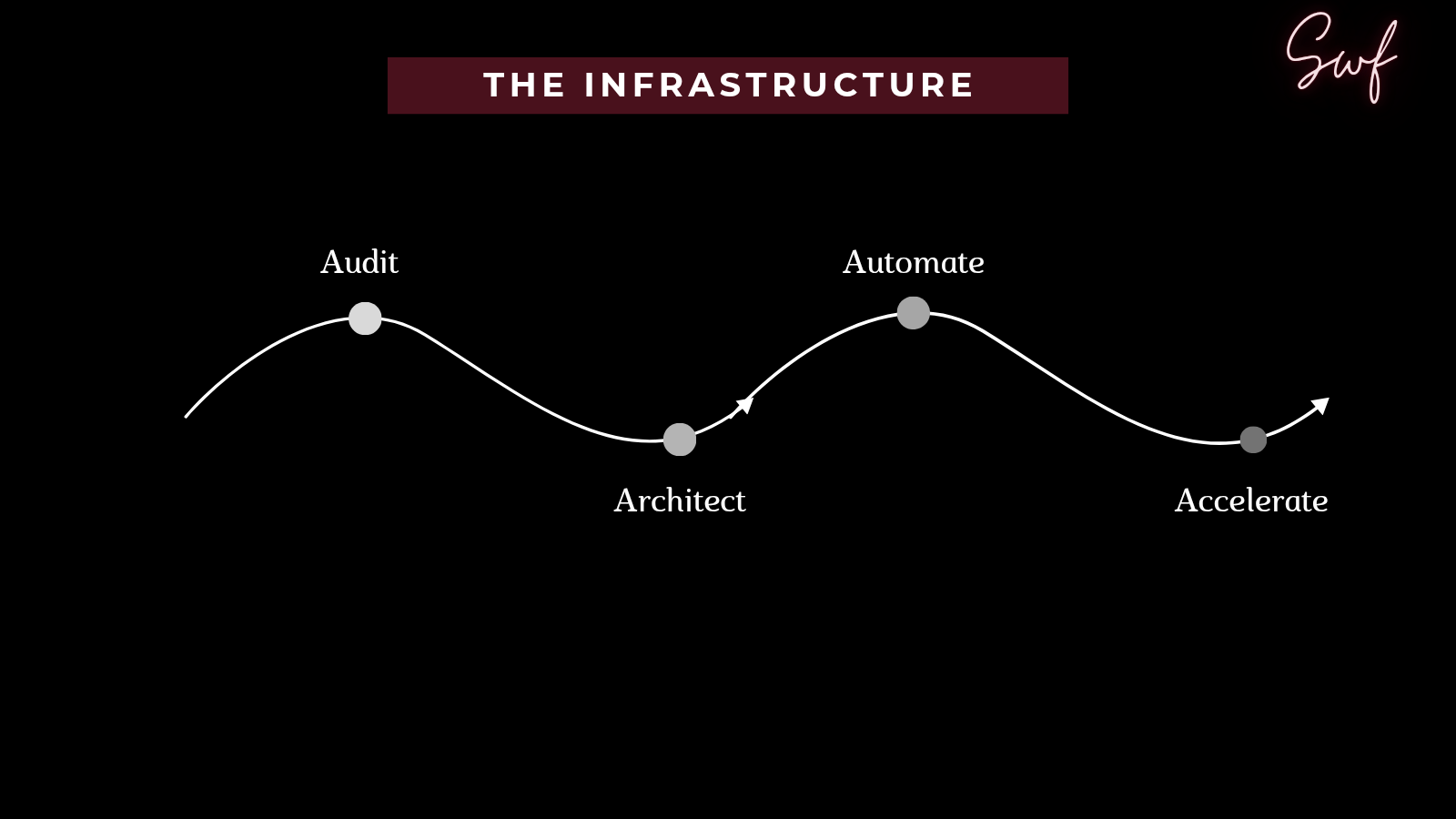
Stage 1: Audit
The question this answers: Where is the money actually going?
Most people skip this entirely. There's a vague sense of what comes in and a vaguer sense of what goes out. The big numbers feel familiar but the leaks stay invisible. And the leaks are where businesses and personal finances quietly bleed out.
On the personal side, this means tracking every dollar. Not with an app that categorizes things and makes it easy to ignore the results. A system that forces honest contact with the real numbers. What subscriptions are still running that got forgotten. What "small" purchases are compounding into a second rent payment. What the actual cost of living is, not the assumed version.
On the business side, this means knowing revenue sources, expenses by category, profit margins by product, and effective tax rate. Not annually. Monthly. Variable income requires more frequent audits, not fewer.
The audit isn't a one-time event. It's a recurring practice. I run mine monthly, sometimes weekly depending on how heavy it gets. It takes less than an hour now because the system does most of the work. But that first audit changes everything. Seeing it all laid out with nowhere to hide rewires how every financial decision gets made after it.
Stage 2: Architect
The question this answers: What system holds money before more gets chased?
Once it's clear where money is going, the next step is building the structure that directs it intentionally. This is the stage most people never reach because the jump goes straight from "make money" to "make more money" without ever building the container.
On the personal side, architecting means building a split system. Mine runs 60/20/20. 60% for living expenses, 20% for freedom (savings, investing, future me), 20% for joy and what comes after. It scales with variable income. A $5,000 month and a $1,200 month both run through the same architecture. The percentages hold. The system doesn't break when income fluctuates and nobody has to make a new decision every time a payment lands.
On the business side, architecting means separating accounts, establishing tax allocation before it's owed, setting up profit-first splits so profit isn't what's "left over" after expenses. It gets pulled first. It means building an LLC, opening a proper business bank account, creating the legal and financial separation that protects when things scale and when things go sideways.
Architecting is unsexy. Nobody posts about it. But it's the stage that determines whether the next $10,000 month actually builds wealth or just passes through on its way to expenses that weren't planned for.
Stage 3: Automate
The question this answers: How does the system run without constant manual decisions?
Every financial decision made manually is a decision that can go wrong under fatigue, emotion, or distraction. Automation isn't about being lazy. It's about building a system that executes the financial architecture without requiring willpower every time.
On the personal side: automatic transfers on payday. Savings that move before the money is even visible. Investment contributions that happen whether anyone remembers or not. The architecture from Stage 2 becomes self-executing. The worst financial month is still structurally sound because the system doesn't depend on how anyone is feeling that week.
On the business side: invoicing systems, payment processing, recurring revenue models, and financial tracking that updates without manual entry. A business that collects, allocates, and reports money without a human spreadsheet running it.
This is also where revenue model matters. A business that depends on manually launching something every month to generate income is not automated. It's a treadmill with a cash register. Products that sell while the founder sleeps, subscriptions that renew without a new pitch, systems that process payments without involvement. That's automation at the revenue level, not just the expense level.
Stage 4: Accelerate
The question this answers: How does growth happen now that the foundation can hold it?
This is the stage everyone wants to start at. More products. Higher prices. New revenue streams. Scale.
But acceleration without infrastructure is how creators burn out, go broke on a good year, or build a business that makes money but owns them completely.
When Stages 1 through 3 are solid, acceleration looks different. There's no guessing about whether a new product investment is affordable because the audit answers that. There's no wondering where revenue from a big launch will go because the architecture directs it. There's no manually processing every new sale because the automation handles it.
On the personal side, this is where money compounds. Investments grow. Net worth builds. The gap between income and expenses funds the life that was actually designed, not just the one that got fallen into.
On the business side, this is product stacking, pricing strategy, and revenue diversification. The second product launches. The price on the first one goes up. A subscription tier gets added. The brand deal gets taken because the money has somewhere to go, not because it's needed to survive.
Acceleration is the reward for building infrastructure. It's also the part that breaks everything when the first three stages got skipped.
Why Both Tracks Matter
The people I talk to most often have one track working and the other in chaos. A business generating $8,000 a month but personal finances in a wreck. Credit card debt accumulating. No savings. No investment strategy. Spending everything earned because "the business is growing." Or the opposite: a perfect personal budget but business revenue that's sporadic, untracked, and structurally incapable of funding the life that was planned.
For a one-person business, these aren't separate problems. They're the same system. And the Infrastructure Method treats them that way. Fixing only one side is how someone ends up earning more and still feeling like nothing is holding.
The Real Proof
I didn't build this as a concept to sell. I built it because I needed a business that could survive losing its audience overnight. And it did.
55,000+ followers gone. 10 million monthly views gone. Three platforms gone. Revenue intact. Not because of luck. Because the money had somewhere to go, the system was already running, and the infrastructure didn't depend on the thing that disappeared.
That's what infrastructure does. It makes the things that can't be controlled (algorithms, platform decisions, audience volatility) irrelevant to the things that can be: revenue, profit, freedom.
A business that doesn't buy freedom is just a job with extra steps. The Infrastructure Method is how the other kind gets built.
If this framework landed, the rest of the brand lives here. I write about money, systems, and building for creators and soloprenuers. Built on math, not motivation.
New subscribers get the free Profitable Creator Calculator. Three numbers most finance content ignores: what it takes to break even, what it takes to be profitable, and what freedom actually costs.
Starting Stage 1 is the hardest part. Not because auditing is complicated. Because most people are carrying the same invisible weight without a system to lift it:
Not knowing where money actually went last month. Earning inconsistently and having no structure that survives the low months. Mixing personal and business finances until both feel out of control. Setting aside nothing for taxes until the bill arrives. Making more money this year than last year and somehow feeling no further ahead.
The Money Audit System was built to solve every one of those problems in one sitting. Two system (personal and business), two How-to guides. The system runs the audit so nobody has to stare at a blank page wondering where to start. Every leak found. Every dollar accounted for. One-time purchase.
Get profitable. Stay free.
— Jessica Onne
P.S. The questions most people sit on for months are usually one conversation away from becoming a system. If that's where things are right now, message me directly.
"Architecting is unsexy. Nobody posts about it" this is the conversation im wanting to have. Start talking about mechanics and you get crickets from people who sell identity.
This is the absolute truth. Losing 55k followers and keeping your income intact is the ultimate proof that financial infrastructure beats hype every single time.
Your 4-stage system mirrors the exact blueprint I used to go from grinding 2–3 jobs to total financial freedom:
Audit & Architect: I spent decades tracking every penny, working multiple jobs, and saving aggressively to buy my first rental property.
Automate & Accelerate: Today, I keep a strict safety net of a few months' expenses so I never panic, and I let my rental and covered call ETF cashflow automatically compound in a set-and-forget loop.
When you build the plumbing first, external chaos becomes completely irrelevant to your freedom. Truly an incredible piece!