


Most writers spend months perfecting a newsletter nobody reads.
They obsess over the headline. They rewrite the opening paragraph eleven times. They design the perfect welcome sequence, build the perfect about page, and pick the perfect publishing day. Then they hit send into a void of 47 subscribers and wonder why nothing's growing.
The problem isn't the newsletter. The problem is that nobody's walking through the door.
Here's the thing nobody told me when I started: on Substack, your newsletter is the room, but Notes is the door. And if the door is closed — or worse, if you're not even standing near it — it doesn't matter how beautiful the room is. Nobody's coming in.
I learned this the slow way. I spent the first stretch of building this Substack treating Notes like an afterthought. A place to dump my newsletter title with a link and call it a day. My subscriber count moved like cold honey. Then I started studying how the writers I admired were actually growing — and almost every single one of them had the same answer. It wasn't the newsletter. It wasn't the launch strategy. It wasn't the niche. It was Notes. Daily, intentional, format-driven Notes.
So I rebuilt my entire approach. I stopped treating Notes as the side dish and started treating it like the main course. I tested formats. I tracked what landed. I cut what didn't. And over time, I built a framework of seven Note formats that I now rotate through every single week — each one designed to do a specific job in the growth engine.
Some bring discovery. Some build trust. Some spark replies. Some convert scrollers into subscribers in a single line. Together, they're the reason my feed actually moves now, and the reason I'm no longer publishing into a void.
This newsletter is the full breakdown. The seven formats, what each one does, when to use it, and an example of every single one written in the voice I actually use. By the end, you'll have a Notes framework you can start running tomorrow — no guesswork, no burnout, no more shouting into a feed that doesn't shout back.
If you've been treating Notes like a chore instead of a strategy, this is your sign to flip it. The writers who'll dominate Substack in the next year aren't the ones with the prettiest newsletters. They're the ones who figured out the door.
Here's the full framework, with example Notes you can adapt for your own feed:
1. The 60-Second Save
Solve one specific, annoying problem in under 60 seconds. No fluff, no story, no setup. Just the problem and the fix.
These convert like crazy because the reader immediately thinks "if she knows this, what else does she know?" — and they subscribe to find out.
The key is specificity. Don't write "how to grow your newsletter." Write "your Substack welcome email is probably broken on mobile — here's the 30 seconds fix."
Example:
"If your Substack emails are landing in promotions instead of the main inbox, it's not the algorithm. It's the link count. Cut your links down to 3 or fewer per email and watch your open rates jump within a week."
Why it works: It's specific, it's useful, and it makes the reader feel like they got something for free. Quick Fix Notes also get saved and shared, which extends their lifespan in the feed.
2. The Community Lift
Promote other people. No pitch, no angle, no "but first, let me tell you about my newsletter." Just genuine celebration of other creators doing the work.
This is the format that most writers skip because it feels counterintuitive — why would I send traffic to other people when I'm trying to grow? The answer is that generosity compounds faster than self-promotion ever will. When you lift other creators, you become the person their audience wants to follow. You build warm relationships with writers who will reciprocate for years. And you train the algorithm to associate your name with the creators you respect.
Example:
"drop your substack below — doesn't matter if you have 10 subscribers or 10,000. I'm going to read every single one of them this weekend. the creators who'll define this platform aren't the ones who already made it. they're the ones still building in the quiet."
Why it works: It creates a comment thread full of links (which boosts engagement), introduces you to new writers who will remember you, and positions you as a community builder instead of a self-promoter. The algorithm rewards long comment threads, and your name gets attached to every writer who drops their link.

3. The Lived Lesson
Share a real moment, then connect it to a real lesson. Not a story that happened to someone else. Not a hypothetical. Something that actually happened, told in your own voice, with a takeaway that makes the reader pause.
These are the Notes that turn casual scrollers into loyal subscribers because they make the reader feel like they know you.
Example:
"i almost didn't launch my first digital product. spent weeks building it, wrote every page myself, designed the tracker, and two days before launch i convinced myself nobody would buy it. hit publish anyway. the first sale came in 6 hours later. the lesson wasn't 'believe in yourself.' the lesson was: the doubt never actually goes away. you just learn to launch alongside it."
Why it works: It's vulnerable without being performative. It's specific enough to feel real. And the lesson lands because it contradicts the usual "believe in yourself" advice with something the reader recognizes from their own life.
4 The Hot Take
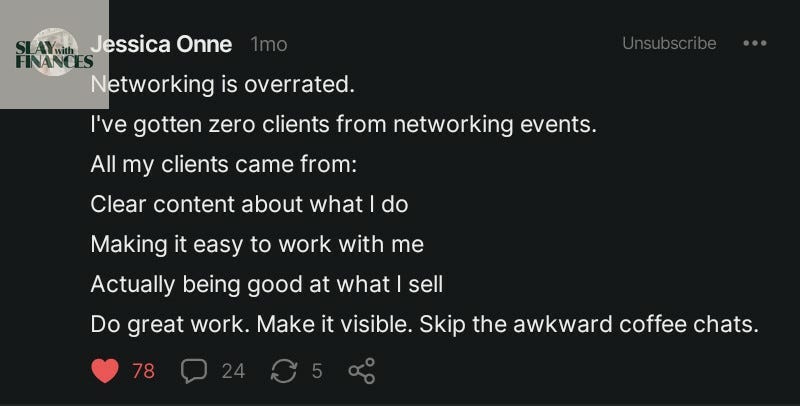
Challenge something everyone in your niche assumes is true. Not to be edgy. Not to start fights. Just to say the thing most writers are too cautious to say out loud.
Hot Take Notes are the fastest way to build a memorable voice, because agreeable content disappears in the feed and disagreeable content gets screenshot and shared.
Example:
"stop perfecting your newsletter. start optimizing your Notes. your newsletter is the room. Notes is the door. if nobody's walking through the door, it doesn't matter how beautiful the room is."
Another example:
"most budgeting advice for women in their 20s is either condescending or completely detached from how a real paycheck works. cut the lattes. track every cent. build a 47-tabs spreadsheet. none of it works because none of it was written for us. we don't need more tips. we need better systems."
Why it works: Hot Take Notes polarize, and polarization is the engine of growth on every social platform. The people who agree with you become fans. The people who disagree remember you. Either way, you win the feed.
5. The Honest Post
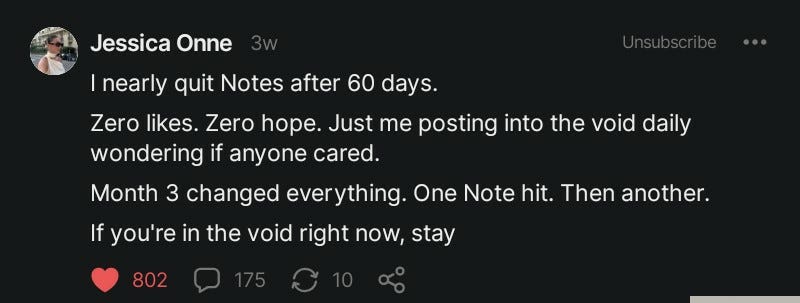
Share a failure, a fear, or a moment of doubt. Not a curated version of it. The real one.
These are the Notes that break the para social wall between writer and reader, because most creators never post them. When you do, you stand out instantly.
The trick is to avoid making vulnerability a pity party. Share the low moment, then name what you learned or what you're doing next. Vulnerability with direction is magnetic. Vulnerability without direction is exhausting.
Example:
"my first digital product launched and made zero sales in the first week. not one. i had two reactions: one was to quietly delete it and pretend the launch never happened. the other was to sit down and figure out exactly what went wrong. i chose the second. sales came later. but the real lesson was that the first week of any launch is rarely the real story."
Why it works: It's honest about a failure most creators hide. It positions you as someone who learns from hard moments instead of running from them. And it implicitly teaches a lesson about resilience without ever using the word.
6. The Behind-the-Scenes
Share real numbers, real milestones, or real updates about what's happening in your business right now. Not vanity metrics. Not borrowed stats. The actual, unglamorous, in-progress stuff.
Transparency is the fastest trust-builder on Substack, and readers are starved for it. Most creators only share the wins. When you share the wins and the climb, you become the creator readers actually trust.
Example:
"just crossed 1,000 subscribers on here. took longer than i thought it would, felt smaller than i expected, and mattered more than i can explain. next stop: 5,000. writing every day, posting Notes every day, and documenting the climb so when i get there you'll know exactly how it happened."
Why it works: It's specific, it's honest, and it invites the reader to come along for the journey. Behind-the-scenes Notes also build an ongoing narrative across your feed, which gives readers a reason to keep checking back — they want to know what happens next.
7. The Conversation Starter
Ask a real question. Not a rhetorical one. Not a "thoughts?" tacked onto a statement. A genuine question you actually want the answer to.
These Notes are the hardest to write because the temptation is to dress them up with commentary. Resist it. The best Conversation Starters are short, direct, and impossible to scroll past without wanting to reply.
Example:
"what's the one thing you wish you'd known before starting your newsletter? be specific. i'm taking notes, not vibes."
Another example:
"honest question for the women building brands online: what does financial freedom actually look like for you? not the generic answer. the real one."
Why it works: Questions drive comments, and comments drive distribution. Every reply pushes the Note higher in the feed, and the comment thread itself becomes content — something new readers can land on, scroll through, and join. Conversation Starters also double as free market research. Every reply is data about what your audience actually thinks, struggles with, and wants to read next.
The honest part before we go further
I want to say this clearly because most creators teaching frameworks won't: I'm not perfect at this.
Some of my Notes flop. I'll spend twenty minutes crafting what I think is a sharp contrarian take, hit publish, and watch it sit at four likes for three days. I'll write a honest post I'm sure is going to land and get nothing back. I'll post a Conversation Starter and hear crickets. It happens every single week, and it still stings every time.
But some of them genuinely move the needle. A single community lift Note has brought in more subscribers in 48 hours than a whole week of newsletter promotion. A throwaway the 60 seconds save I wrote in two minutes outperformed posts I spent an hour on. A Honest post I almost didn't publish became the reason a handful of readers told me they finally subscribed.
That's the actual game. It's not about writing the perfect Note. It's about writing enough Notes that the ones meant to land have a chance to. The framework isn't magic — it's a structure that raises your floor so even your "bad" Notes do some work, and your good ones can compound.
I'm sharing the formats that have grown me, not the formats that work every time. There's a difference, and I think the writers who pretend otherwise are the reason most people quit Notes after two weeks.
Volume protects you. Consistency rewards you. The framework just makes sure you're not guessing.
How I rotate the formats
I don't use all seven every day. I rotate based on what I need:
When I want discovery, I lean on Hot Takes and The Community Lift Notes, they get the most reach and bring in new eyes.
When I want trust, I post The lived lesson and Honest Post — they turn scrollers into subscribers.
When I want engagement, I post Conversation Starters and Behind-the-Scenes — they drive replies and signal activity to the algorithm.
When I want to feel useful, I post The 60 seconds save— they convert fast and make readers feel like the subscription already paid for itself.
A good week looks like three Hot Takes, two lived lesson, two Conversation Starters, one The Community Lift Note, one Honest post, and one Behind-the-Scenes. That's ten Notes across seven days — manageable, consistent, and covers every job a Note can do.
The honest part
None of this works if you only do it for a week. Notes is a compound game. The writers who grow on this platform aren't the ones who post the best individual Note — they're the ones who show up every day for months, testing formats, watching what lands, and adjusting.
I'm still in the middle of that climb. 1,300+ subscribers down, a lot more to go. But this framework is the one I use every day, and it's the reason my feed is actually starting to move.
If you're building on Substack and you've been sleeping on Notes, try one format this week. Just one. See what happens. Then come back and try another.
The door is open. Walk through it.
Here's the thing: this framework only works if you actually use it. So let's make this easy.
Pick one format from the seven above — just one — and post it on Notes within the next 24 hours. Then come back to this newsletter and reply with which one you tried. I'll personally read it, restack the ones that hit, and tell you exactly what I'd tweak to make it land harder.
That's the deal. You post one Note. I help you make the next one better.
And if you want the rest of what I'm building — the honest breakdowns of what's working in money, creator business, and growing online without the guru nonsense — subscribe below. Two (2) newsletters a week.

The void is real
Really! Thank you so much, means a lot ❤️