


73% of adults say they're "doing okay financially." Then you ask them to cover a $400 emergency and 37% can't do it without borrowing. The average household made $104,000 last year and still spent $78,000 of it, before they even thought about saving. Credit card debt hit $1.23 trillion. And somehow, we're all walking around pretending we've got it figured out.
We don't. Most of us are winging it with a notes app and a prayer.
That's why I built this series.
Welcome to "What I'd Do With Your Paycheck" Reset I — the part of the 30-Day Financial Lock-In where a real person sends me their real income, real expenses, real debt, business finance, real investments everything, and I redesign their budget publicly. No names. No judgement. Just math.
The goal isn't to shame anyone. The goal is to show you what a working money system actually looks like from the inside, not a textbook version, not a screenshot from a finance influencer who makes $40K a month and tells you to "just invest." A real person. A real paycheck. A real life.
And for the first one? She found me.
She slid into my DMs after a story I posted on Instagram about toxic money habits. We started talking. Then she sent me everything her income, her savings buckets, her investments, her debt, her insurance, her food budget, her plans for the next two years. All of it.
She's a first-generation lawyer. Grew up just above the poverty line. Nobody taught her a single thing about money. She built every system she has from scratch, by being tired of not knowing where her money was going.
She negotiated a $10,000 raise this year. Her strategy? She walked in with her receipts, her performance, her case and then she said, "I'd like a round number, because I like whole numbers." She got $5,000 on the spot. The other $5,000? It came two months early.
She has debt she's paying off two years ahead of schedule. She has 26 investments across multiple platforms. She has 10+ savings buckets, including one for snowboarding, one for a trip to Peru and Brazil next year, and one for her 30th birthday business class flights. She has four types of insurance. She auto-invests weekly. And she has a "whole numbers" rule where she transfers the loose change into savings so her accounts always land on round numbers.
She makes $906.69 a week after tax.
And somehow, every single dollar has a job.
This is her breakdown. And these are the things I'd change:
SUBMIT YOUR PAYCHECK — ANONYMOUSLY
If you're reading this thinking "I want her to do mine" — I will. Message me privately and I'll send you directions on how or submit your numbers. Your income, your expenses, your debt, your savings, business finance, the whole mess. I'll redesign it and publish it here. No names. Just the truth.
—Back To The Reset—
Here's what she's working with. All numbers are in NZD, weekly unless stated otherwise.
Income:
$906.69/week take-home after tax. KiwiSaver ($94.73) and student loan ($105.84) come out before she ever sees the money. She doesn't count them. Smart.
The savings buckets:
This is where it gets interesting. She doesn't have one savings account. She has ten.
Car account $2/week auto, plus $240/fortnight for the loan, plus $0.69 auto transfer to round up to a whole number (because she likes whole numbers, obviously).
Faux emergency — $2/week.
Snowboarding — $2/week.
Peru — $2/week plus $18 every fortnight.
Christmas — $20/week. Currently sitting at $380.
Oopsy account (her actual emergency fund) — $62/week. Currently at $1,840.
Phone bill — $25/week parked as "savings" until she converts it to a direct payment.
30th birthday fund — already started. $38 in there.
The investments:
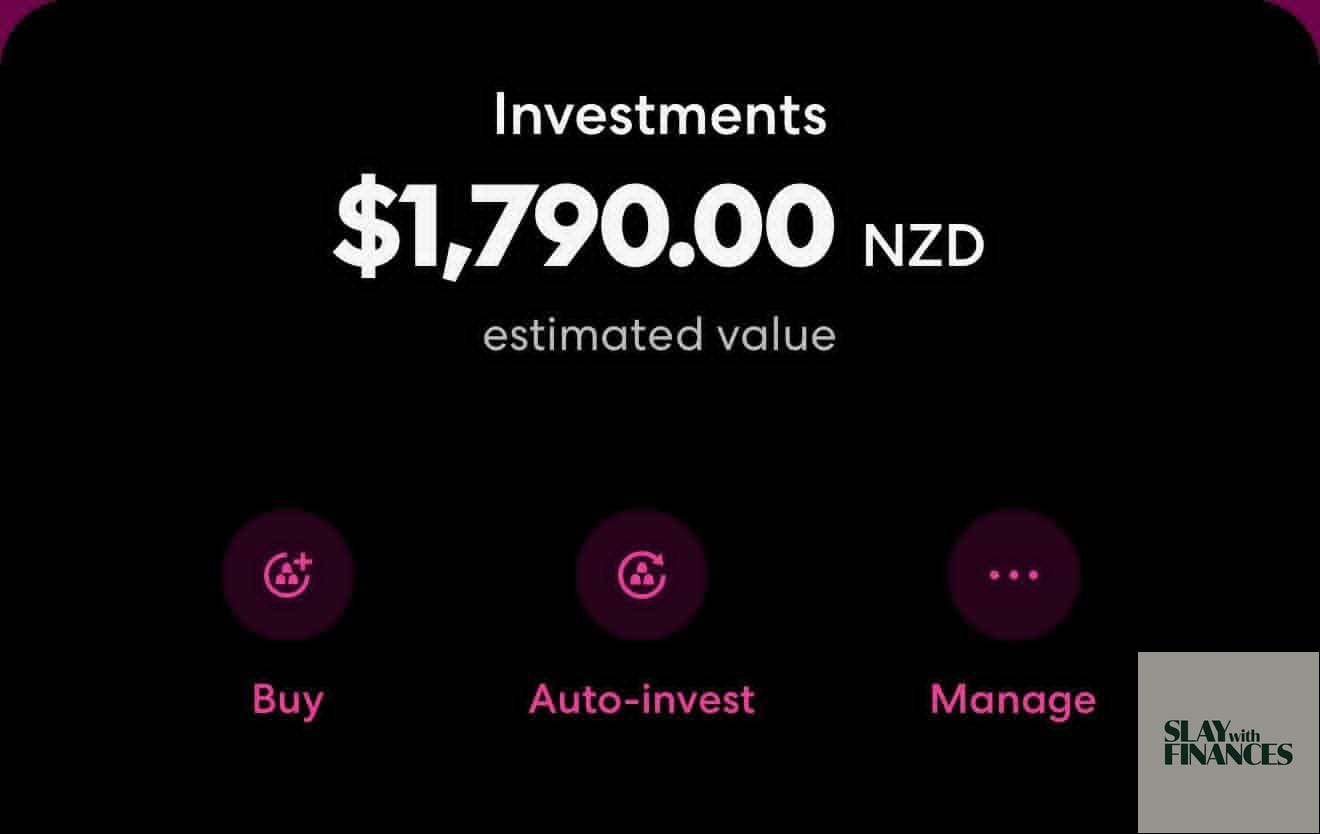
$5/week into Sharesies. Currently at $1,790 across 26 holdings ETFs, REITs, individual companies. She runs what she calls a satellite strategy "on steroids." Core holdings are ETFs with individual picks around the edges. If something hits green and no longer aligns with her values, she sells it.
She also has a separate high-growth portfolio on Sharesies. $50.07. Small but active.
KiwiSaver is sitting at $17,020. Socially Responsible High Growth fund. $544 in earnings since inception plus $151 in government contributions. That's free money she's collecting just by having the account open.
The fixed expenses:
Weekly: $250 rent/power/wifi. $25 gym. $100 food (split with her partner, they get meat from family and only pay for it once a year, which is a cheat code honestly).
Fortnightly: $30 medical insurance. $48 car insurance. $47 contents insurance. $22 additional medical insurance. $240 car loan.
Monthly: $2 Apple. $20 Spotify. $20 Disney. $20 Neon. $10 HAYU.
Plus irregular expenses — waxing, laser hair removal, laser tattoo removal, budgeted from whatever's left over.
Whatever survives all of that gets split between a beauty/things account and her Sharesies account. This week, that was $60 — $30 each way.
What she's doing right (and most people aren't):
Before I touch anything, let me be clear, this woman is not here because she's failing. She's here because she's winning and wanted someone to check the math.
Every single dollar has an assignment before it arrives. That's not normal. Most people on double her income cannot tell you where their last $200 went. She can tell you where her last $0.69 went.
She's paying off debt ahead of schedule while simultaneously investing, building an emergency fund, saving for a trip to Peru and Brazil, funding a 30th birthday business class flight, and putting away Christmas money in May. In May.
She has four types of insurance. Four. Medical, additional medical, car, and contents. At her age, with her income, that level of protection is rare and smart.
The automation is the real flex. Most of this runs without her thinking about it. The money moves on payday, lands where it's supposed to, and she lives on what's left. That's not messy. That's a machine with personality.
What I'd change:
1. The micro savings need a promotion.
$2/week into faux emergency. $2/week into snowboarding. $2/week into Peru. These aren't savings, they're gestures. At $2/week, the snowboarding fund will take over a year to hit $100.
I get it, the point is the habit not the amount. But once the debt clears in December and she frees up $200/week, these buckets need to be the first ones to get a raise. Peru and Brazil are happening next year. $2/week won't get her there. That $200 debt rollover should funnel directly into the travel fund for at least a few months.
2. The streaming subscriptions need an audit.
Spotify, Disney, Neon, HAYU, Apple. That's $72/month on streaming. The question isn't whether she can afford it — she clearly can. The question is whether she's using all five every month. Rotating two on and two off saves $40/month, which is $480/year straight into Sharesies. That's 96 extra weeks of investing at her current $5/week rate, almost two years of contributions from one change.
3. The emergency fund timeline needs a reality check.
The oopsy account is at $1,840 with $62/week going in. At that rate she hits $10K in about 131 weeks, roughly 2.5 years. That's fine if nothing goes wrong. But once the debt clears in December, redirecting even half of that freed-up $200/week into the emergency fund would get her to $10K by mid-2026 and $20K before 2027 ends. Speed matters here because until the emergency fund is solid, one car repair or one medical bill forces her back into debt.
4. The "whatever's left over" split needs a system.
$30 to Sharesies and $30 to beauty this week. But next week it could be $10 or $80. The inconsistency means her investment contributions are unpredictable. A simple rule would fix this , something like 60% investments, 40% fun — applied to whatever's left. It doesn't change the total. It just removes the decision every single week.
5. The 26 investments need a 15-minute overlap check.
She admitted she tried to check the overlap between her ETFs, saw a wall of FTSE names, and gave up. Fair. But with 26 holdings, she's almost certainly holding the same companies in multiple places without knowing it. That's not diversification, that's duplication disguised as diversification. One afternoon with her portfolio open and a simple checklist would reveal whether she's actually spread out or just spread thin.
6. The $8K self-loan needs a repayment plan.
She took $8K from herself to cover a surgery. She mentioned it once. There's no visible repayment structure for it. The beauty of owing yourself is there's no interest and no deadline. The danger is exactly the same, no interest and no deadline means it never gets repaid. Even $20/week gets that $8K back in under 8 years. $50/week does it in 3. Once the debt is cleared, this should be on the list.
This is issue one. every issue, a new paycheck. a new breakdown. a new system built from scratch. If you're not subscribed, you're reading this late, and the next one might be yours.
hit Subscribe so you don't miss it. it's free.
Your turn.
If you're reading this thinking "I want her to do mine" I will.
Send me your paycheck anonymously. Your income, your expenses, your debt, your savings, the whole mess. I'll redesign it and publish it right here. No names. No judgement. Just the math and a system that actually works for your life.
SUBMIT YOUR PAYCHECK →
The next Reset breakdown ii drops in fewdays. Subscribe so you don't miss it.
And if you want the same kind of tracker she uses to automate her money, the one with 6 tabs covering everything from budgeting to investments to debt payoff, the Millennial's Finance Guide walks you through the full setup.
This is really interesting!